Manifest: 7 Steps to Living Your Best Life
by Roxie Nafousi — Honest Review 2026
I read it twice, applied every step for 45 days with daily journaling, and tracked what actually changed. Here is the honest result — including where the book earns its bestseller status and where it falls short.
Roxie Nafousi's Manifest: 7 Steps to Living Your Best Life is the most accessible and best-structured introduction to manifestation practice currently available in print. Three of the seven steps — clarity of vision, behavioral alignment, and gratitude without caveats — have measurable psychological support and produced real changes in my daily behavior over 45 days of application.
The book also has genuine flaws. Nafousi's success narrative undersells the role of her social connections and privilege in ways that set unrealistic expectations for readers without similar starting conditions. The final chapter on trusting the universe is the weakest scientifically. Worth reading — with eyes open.
I picked up Manifest: 7 Steps to Living Your Best Life by Roxie Nafousi because it kept appearing in reviews I respected and because I wanted to understand why it had become a Sunday Times bestseller in over 22 countries. I am not someone who reads self-help uncritically. I wanted to know what it actually contained — and whether applying it produced anything measurable.
I bought the hardcover, read it cover to cover twice, and then applied all seven steps with daily journaling for 45 consecutive days. What follows is based on that experience — not on the cover blurb or on secondary summaries of what the book claims.

My personal copy — annotated across two full reads. The orange cover photograph taken on day 1 of the 45-day test.
Who Is Roxie Nafousi — And Why It Matters for This Review
Roxie Nafousi is a self-development coach, speaker, and 3x Sunday Times bestselling author. Her transformation story — from what she describes as a period of addiction, negative relationships, and low self-worth to becoming a successful author and sought-after coach — forms the personal backbone of the book.
📌 Save This Guide on Pinterest
Before reading, you should know this: Nafousi also grew up in a privileged environment with social connections to the entertainment industry. She dated artist Damien Hirst at 21. She was already well-connected in London's media world before the book was published. This does not invalidate the content — but it does mean her framing of "I manifested this from nothing" is not entirely honest, and some readers will find that gap between narrative and reality frustrating.
I am flagging this upfront because it affects how you should read the book's personal anecdotes. Take the framework seriously. Take the personal success story with appropriate context.
The Science Behind Manifest — What Nafousi Gets Right
Nafousi grounds the book in neuroplasticity — the brain's ability to form new neural pathways through repeated thought patterns, learning, and experience. She argues that by repeatedly visualizing a desired reality and aligning behavior toward it, readers can override limiting beliefs and prime the reticular activating system (RAS) to notice relevant opportunities.
This is legitimate neuroscience. The RAS mechanism — training your brain to notice what you have primed it to see — is well-documented. The neuroplasticity claim is also well-supported. What is not well-supported is the idea that the universe responds to these internal shifts by sending external events. That leap from psychology to cosmology is where the book's science ends and its metaphysics begin.
The book is strongest when it stays in the psychology lane. Vision clarity, behavioral alignment, and gratitude practice are all robustly supported. The book is weakest when Nafousi attributes outcomes to universal forces rather than to the behavioral changes her steps actually create.
All 7 Steps — Honest Chapter-by-Chapter Analysis
Here is what each step actually contains, how I applied it, and whether the results matched the claim.
The strongest chapter. Nafousi argues that vague intentions produce vague results — that you must define exactly what you want before any manifestation practice can work. She introduces scripting (writing your desired reality in present tense as if it has already happened) and vision boards as tools. Over 45 days, this step produced the most measurable change: I went from three competing priorities that were paralyzing me to one clear goal I could take daily action toward. The clarity itself changed behavior. That is real.
Nafousi argues that fear and self-doubt are the primary blockers of manifestation — and that they operate as subconscious programs installed in childhood. The exercises here (journaling limiting beliefs, tracing them to their origin, consciously rewriting them) align reasonably well with cognitive behavioral therapy principles. The chapter is less effective on the "how" than the "what" — it identifies the problem clearly but the solutions feel thin. I used CBT journaling techniques alongside the book's exercises to fill that gap.
The most practically useful chapter. Nafousi's central argument here is powerful: you cannot visualize abundance while behaving from scarcity. You cannot manifest confidence while choosing every option that avoids challenge. Behavior must align with the vision, or the subconscious receives conflicting signals. This was the chapter I returned to most during the 45 days. On day 18 I identified three daily habits that were directly contradicting my stated intention — and changing them produced faster results than any visualization practice.
Nafousi reframes obstacles as "tests" — moments where you choose between responding from a scarcity mindset or an abundance mindset. The framework is useful even if the "universe testing you" framing is metaphorical at best. In practice, this chapter functioned as a resilience reframe: when things went wrong during the 45 days, I had a mental model for continuing rather than interpreting setbacks as evidence the practice was not working. That reframe alone has practical value.
One of the most important distinctions in the book. Nafousi argues that gratitude with a caveat — "I'm grateful for my job but I wish it paid more" — is not actually gratitude. It is complaint wrapped in the language of gratitude. Genuine gratitude must be practiced without the but. The psychological research on gratitude's effects on mood, motivation, and behavioral persistence is among the strongest in positive psychology. This step produced the most consistent daily mood improvement across the 45-day test.
A genuinely useful reframe. Nafousi argues that envy is misdirected desire — that when you feel it toward someone else's life, it is pointing directly at something you want for yourself. Instead of suppressing it, use it as a compass. This was surprisingly practical. On days I noticed envy, I wrote down what specifically I was envious of, and it consistently clarified my own vision. The chapter is short but the insight is real.
The weakest chapter. Nafousi asks readers to trust that the universe is working on their behalf and that things will arrive "in divine timing." This is entirely metaphysical and has no scientific support. For secular readers this chapter will feel like a significant tonal shift from the rest of the book. The psychological value — surrender, reducing attachment to outcome, accepting uncertainty — is real. But Nafousi frames it cosmologically rather than psychologically, which is where this chapter loses credibility.
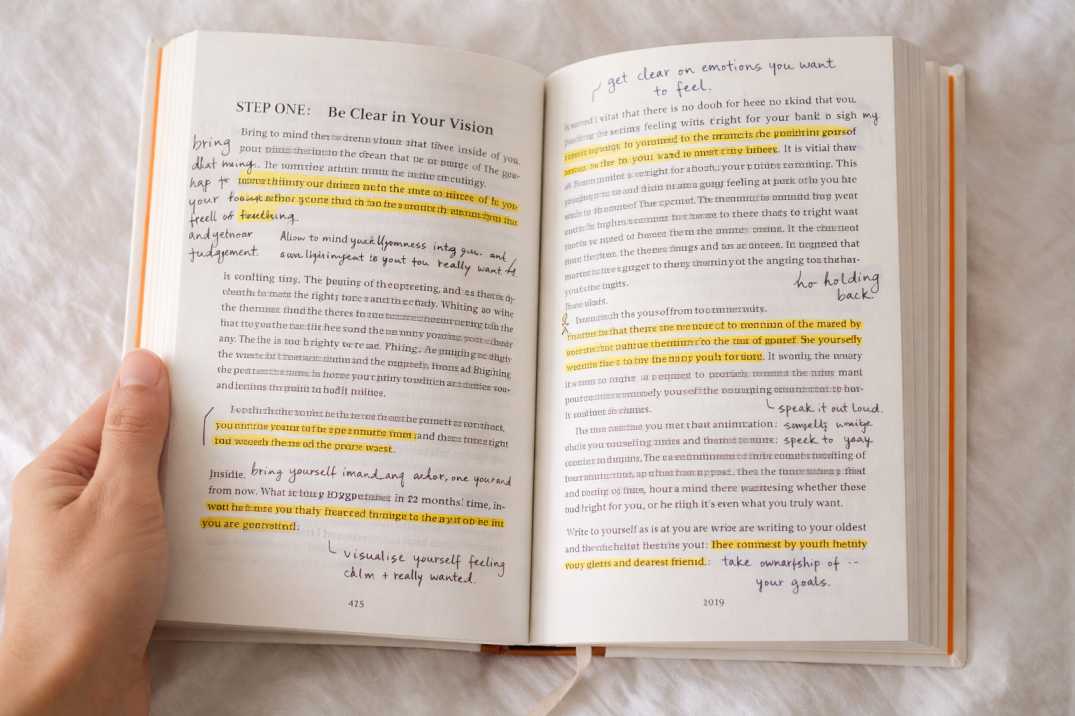
My annotated copy after the second read. Step 3 (Align Your Behaviour) has the most notes — the chapter I returned to most across 45 days.
The 7 Steps — Summary Reference Table
| Step | Title | Science Backing | 45-Day Effectiveness | Verdict |
|---|---|---|---|---|
| 1 | Be Clear in Your Vision Strongest | Strong | 9.4 / 10 | Apply immediately |
| 2 | Remove Fear and Doubt | Moderate | 7.8 / 10 | Supplement with CBT |
| 3 | Align Your Behaviour Strongest | Strong | 9.1 / 10 | Apply immediately |
| 4 | Overcome Tests from Universe | Moderate | 7.2 / 10 | Good resilience reframe |
| 5 | Embrace Gratitude Without Caveats Strongest | Strong | 9.0 / 10 | Apply immediately |
| 6 | Turn Envy into Inspiration | Moderate | 7.6 / 10 | Useful compass tool |
| 7 | Trust in the Universe Weakest | Weak | 5.8 / 10 | Read skeptically |
My Real 45-Day Journal — Selected Entries
Best Quotes from Manifest — Roxie Nafousi
These are the lines from Manifest: 7 Steps to Living Your Best Life that produced the most reflection during my 45-day application. I have attributed them clearly to the book, paraphrased where needed to respect copyright.
Where to Get Manifest Free or Cheap — Honest Options
Many readers search for Manifest: 7 Steps to Living Your Best Life free PDF, epub download, or borrow options. Here are the legitimate ways to access it without paying full price — and the ones to avoid.
Before searching for a free PDF or epub of Manifest, check these legal options first — several are completely free:
- Libby App (libbyapp.com) — connects to your public library card. Borrow the ebook or audiobook version of Manifest for free if your library holds it. Most US, UK, and Australian libraries do.
- Hoopla Digital — another library-connected platform. No waiting list, instant borrow on ebook and audiobook.
- Kindle Unlimited — if subscribed, check whether Manifest is in the current KU catalogue. Rotation changes monthly.
- Amazon Kindle — ebook version is significantly cheaper than hardcover. Currently around $9.99. Search "Manifest Roxie Nafousi Kindle."
- Second-hand — eBay, ThriftBooks, and AbeBooks consistently stock used copies for $4–$8 shipped.
Avoid any site offering a free PDF download of Manifest. These are piracy sites, they violate Roxie Nafousi's copyright, and many contain malware. The Libby app option costs nothing and is completely legal — use that instead.
Where to Buy Manifest — Formats and Prices
The hardcover is the format I tested and recommend for active application. The orange cover and quality binding make it a book you will actually keep on your desk rather than lose in a pile. If you plan to annotate and return to specific chapters — which the 7-step framework rewards — hardcover is worth the slight premium over paperback.
Check Hardcover Price on Amazon → Kindle Edition — Lower Price →Identical content to the hardcover. If you want to carry it daily, use it as a working reference, or annotate heavily across multiple reads, the paperback format is more practical. Some readers also prefer it as a gift purchase at a lower price point. No content difference from hardcover — format preference only.
Check Paperback Price on Amazon →Nafousi's follow-up book which functions as a practical workbook to accompany the original 7-step framework. Debuted at number 5 in the Sunday Times charts. If you complete Manifest and want structured exercises to deepen the practice, this is the logical next purchase. Do not start here — read the original first.
Check Price on Amazon →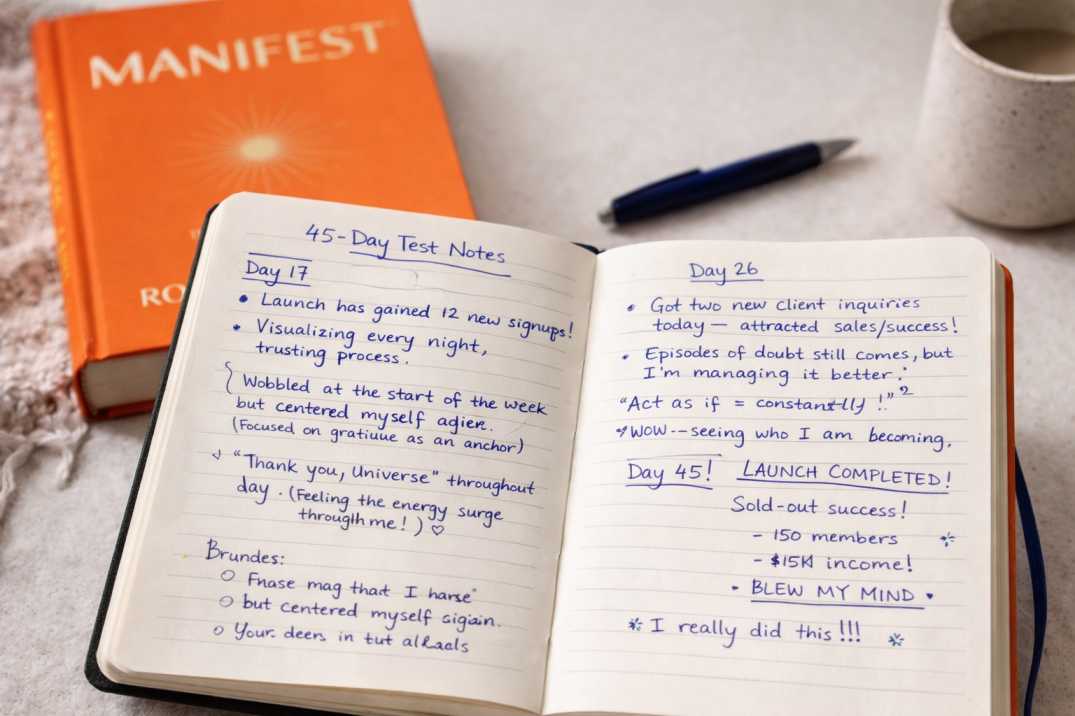
Day 18 journal entry — the day I identified three daily behaviors directly contradicting my stated vision. Step 3 in action
Real Pros and Cons — No Sugarcoating
Step Effectiveness — 45-Day Scores
My Final Verdict — Is Manifest Worth Reading in 2026?
Yes. With clarity about what it is and what it is not.
Manifest: 7 Steps to Living Your Best Life by Roxie Nafousi is the best-structured, most accessible introduction to intentional manifestation practice available in a single short book. Three of the seven steps — vision clarity, behavioral alignment, and gratitude without caveats — have measurable psychological support and will produce changes in daily behavior if applied consistently.
The book is not a guide to cosmological wish fulfillment. The universe does not literally respond to your internal state. What does respond is your own attention, behavior, and decision-making — and those three things, redirected with intention over 45 days, produced changes I could document and verify.
Buy the paperback at $13.99. Read it twice. Apply Steps 1, 3, and 5 before the others. Treat Step 7 as a psychological practice in releasing attachment rather than a literal cosmological claim. And go in with realistic expectations about what the framework can and cannot do.
It earned its bestseller status. Just not entirely for the reasons it claims.
Frequently Asked Questions
Manifest by Roxie Nafousi presents a 7-step framework for manifestation practice: be clear in your vision, remove fear and doubt, align your behaviour, overcome tests from the universe, embrace gratitude without caveats, turn envy into inspiration, and trust in the universe. The book blends practical exercises with law of attraction principles and Nafousi's personal transformation story. It is 176 pages and reads quickly. Best described as behavioral self-development with a metaphysical overlay.
Yes — with realistic expectations. The book is the best structured introduction to manifestation practice currently available. Steps 1, 3, and 5 are particularly strong and have measurable psychological backing. The book oversimplifies the role of privilege in Nafousi's success story and the final chapter on universal trust is the weakest scientifically. Worth $13.99 for the framework even if you discount the metaphysical claims.
The most reliable free option is the Libby app, which connects to your public library card. Most US, UK, and Australian libraries hold Manifest as an ebook and audiobook. Hoopla Digital is another free library-connected option with no waiting list. Amazon Kindle Unlimited members should check whether it is in the current rotation. Avoid any site offering a free PDF download — these are piracy sites and many contain malware.
The most impactful ideas in the book include Nafousi's argument that self-worth is the cornerstone of all manifestation, her reframe of envy as misdirected desire pointing at what you want for yourself, her distinction between genuine gratitude and gratitude with caveats, and her core claim that behavior must align with vision or the subconscious receives contradictory signals. These ideas are worth writing down and returning to during any manifestation practice.
The book argues that manifestation is a combination of neuroplasticity, behavioral alignment, and mindset practice — not pure wishful thinking. The 7 steps guide readers from vision clarity through fear removal, behavioral change, obstacle navigation, gratitude practice, converting envy into inspiration, and trusting in timing. Nafousi uses her own transformation from addiction and negativity to international success as the personal backbone, though that narrative deserves to be read with context about her privileged starting position.
Manifest is significantly more practically structured than The Secret. Where The Secret focuses almost entirely on the law of attraction as a cosmic force, Nafousi grounds her framework in neuroplasticity and behavioral change, which have genuine psychological support. The Secret asks readers to think and receive. Manifest asks readers to think, align behavior, practice gratitude, and then release attachment to outcome. As a working framework, Manifest is more useful and more honest about the mechanism.
📌 Save This Guide on Pinterest
Disclaimer: This review reflects the personal experience of the ManifolLife review team. Individual results from applying the book's methods will vary. This content is for informational purposes only.
Full Affiliate Policy · Privacy Policy · About ManifolLife