You Can’t Be Spiritually Mature
While Staying Emotionally Stuck.
Peter Scazzero’s Emotionally Healthy Spirituality Course says out loud what most American Christians have quietly felt for years: going to church, serving faithfully, and knowing the Bible isn’t the same thing as actually being transformed. This review tells you exactly what the course delivers — and what it doesn’t.
What Is the EHS Course? The Core Premise
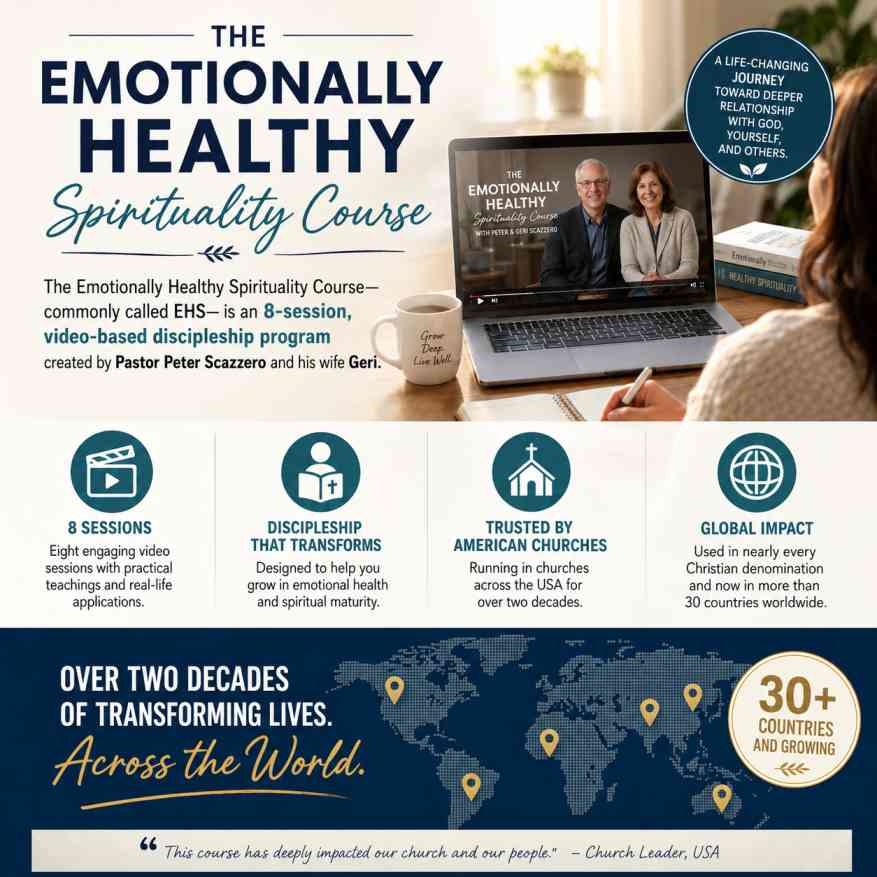
The Emotionally Healthy Spirituality Course — commonly called EHS — is an 8-session, video-based discipleship program created by Pastor Peter Scazzero and his wife Geri. It has been running in American churches for over two decades, used in nearly every Christian denomination, and now spans more than 30 countries worldwide.
The course is built around a single, uncomfortable premise that Scazzero arrived at through painful personal experience: you cannot be spiritually mature while remaining emotionally immature. This sounds obvious when you read it. It hits much harder when you’re sitting in a church that has been doing exactly that for years.
What Scazzero identified — and what made this course resonate so deeply with American Christians across denominations — is a specific pattern. You can be passionate about God, active in ministry, knowledgeable about Scripture, and considered “mature” by every church standard, and still be someone who avoids all healthy conflict, ignores your own emotional world, uses spiritual activity as an escape from God rather than a path toward him, and lacks any real capacity for inner silence or genuine self-awareness. That combination is what the course calls emotionally unhealthy spirituality.
“The combination of emotional health and contemplative spirituality — the heart of the message found in this book — will unleash a revolution into the deep places of your life. This revolution will, in turn, transform all your relationships.”— Peter Scazzero, Emotionally Healthy Spirituality (Updated Edition)
The EHS course addresses this void directly. Over 8 weeks, it guides participants through honest self-examination — looking at family history, emotional patterns, relational habits, and spiritual practices — and offers what Scazzero calls “seven steps to change” that integrate emotional growth with contemplative Christian spirituality. It is not a surface-level program. It requires real vulnerability, honest community, and a willingness to sit with uncomfortable truths about yourself.
That is precisely why it has endured for over 20 years, been completely re-filmed and expanded, and why thousands of American churches still consider it one of the most formative discipleship experiences they offer.
About Peter Scazzero — The Man Who Built This
Peter Scazzero didn’t build this course from a position of success. He built it from failure. As founding pastor of New Life Fellowship Church in Queens, New York — a multiracial congregation drawing from more than 73 countries — he appeared, by every external measure, to be thriving. The church was growing. His ministry was active. He was doing everything right.
Then his assistant pastor led much of the congregation away to start a new church. His wife Geri reached a breaking point and left his church as well. And Scazzero was forced to confront an honest, painful reality: his spiritual life had grown wide but not deep. He had been avoiding conflict in the name of Christianity. Suppressing his own emotions. Using ministry as a way to run from God rather than toward him. Living without healthy limits or boundaries.
The Emotionally Healthy Spirituality Course emerged directly from his journey out of that crisis — from years of therapy, spiritual direction, and studying the integration of emotional health with contemplative Christian tradition. He founded Emotionally Healthy Discipleship, now a global movement, and has written multiple bestselling books including The Emotionally Healthy Leader and the core EHS book itself.
In 2026, Scazzero continues his work through the top-ranked Emotionally Healthy Leader Podcast and the EH Global Leader Conference (September 30 – October 1, 2026, New York City), themed “Redefining Success” and drawing from his forthcoming book Emotionally Healthy Success.
At a Glance — Everything Before You Buy
All 8 Sessions — Exactly What You’ll Cover
This is what most reviews skip. Here is a clear, honest breakdown of what each session actually covers — so you know exactly what you’re committing to before you buy:
Scazzero introduces the defining challenge: the gap between outward spiritual activity and genuine inner transformation. Participants identify specific patterns of emotional immaturity in themselves — often for the first time.
Challenges the common Christian habit of bypassing self-awareness in the name of humility. Participants begin examining their own emotional world — fears, needs, wounds — as sacred ground rather than problems to suppress.
One of the most emotionally demanding sessions. Participants construct a genogram — a multi-generational family map — to identify inherited patterns of sin, trauma, and relational dysfunction, then break those cycles through Christ.
Addresses the “Dark Night of the Soul” — periods of spiritual dryness, doubt, and disillusionment that most church programs treat as problems to solve rather than invitations to deeper transformation.
Challenges the American Christian tendency to rush past grief toward “resurrection” too quickly. Scazzero teaches participants to lament honestly, using the biblical frameworks of Lamentations and the Psalms.
Introduces two ancient contemplative practices — the Daily Office and the Sabbath — as non-negotiable rhythms for sustainable spiritual life. Directly confronts American work-worship culture that exhausts most believers.
Provides a developmental framework distinguishing infant, child, adolescent, and adult levels of faith. Participants identify their current stage and chart a path toward genuine maturity — not just spiritual knowledge.
The culminating session. Participants create a personal “Rule of Life” — an intentional, sustainable structure for their ongoing relationship with God — to keep core practices embedded beyond the 8 weeks.

Who Is This Course Actually For?
Not every discipleship course is right for every person. Here’s an honest breakdown of who will get the most out of the EHS Course — and who will probably find it frustrating.
- Christians who feel spiritually active but internally stuck, burned out, or hollow despite genuine effort
- Church leaders whose ministry is outrunning their inner formation
- Small group participants ready for real vulnerability rather than surface-level sharing
- Anyone who has experienced church hurt or relational breakdown with no framework for processing it
- Married couples wanting to grow spiritually and emotionally at the same time
- Those from backgrounds where expressing emotion or setting limits was discouraged
- Anyone processing painful family history and how it has shaped their faith
- You want a primarily academic or knowledge-based Bible study rather than inner transformation work
- You are not in a genuine community setting — the course loses significant depth alone
- You are new to Christian faith and need foundational doctrine first
- Your church culture does not support honest self-examination or open discussion
- You prefer a shorter commitment than 8 weeks of consistent engagement
- You are looking for theological debate rather than personal application
Real Pros & Cons — Unfiltered Assessment
Most course reviews either uncritically praise the material or dismiss it without engaging its content. This review does neither. Here is an honest accounting based on real participant experiences across American churches in 2025–2026:
- Fills a genuine gap. No other widely used American church discipleship course integrates emotional health and spiritual formation this directly.
- Intellectually honest. Scazzero does not promise easy transformation. He describes his own failures publicly and without self-justification.
- Biblically grounded. Every session is anchored in Scripture — Genesis, Psalms, the Gospels, Paul’s letters — throughout.
- Cross-denominational staying power. Truly used across evangelical, mainline Protestant, Catholic, and charismatic traditions.
- The genogram exercise changes people. Session 3 is consistently cited as the most impactful, uncomfortable, and transformative session.
- Contemplative practices are accessible. The Daily Office and Sabbath content is introduced practically, meeting skeptical Americans where they are.
- Expanded edition is meaningfully improved. The 2022 expanded edition was completely re-filmed with improved video quality and workbook design.
- Free coaching for US leaders. North American leaders who register get a free 60-minute EH Discipleship Course Coach call.
- Three-book format is cumbersome. Multiple Amazon reviewers note that tracking three separate books simultaneously is logistically clunky for small groups.
- Workbook session sequencing has errors. Between-session content for weeks 6 and 7 appears reversed in some editions — frustrating for facilitators.
- Demands real inner work — which some resist. Passive participants will get little from this course. The depth triggers avoidance in highly defended individuals.
- Not a substitute for professional support. The genogram and dark night content surfaces deep wounds that some participants need a therapist to process.
- Sabbath content challenges US productivity culture. Generates the most resistance — not because the content is wrong, but because it directly confronts how Americans live.
- Streaming access expires. The video access code expires December 31, 2027 — relevant for churches planning long-term use.
Buyer’s Guide — Which Pack Should You Get?
The EHS Course comes in several configurations. Here’s exactly what each option provides and who it’s right for:
The Participant’s Pack — Expanded Edition (Best for Individuals)
The standard entry point for anyone joining a course at their church or working through the material personally. Includes the Emotionally Healthy Spirituality book, the 8-session Expanded Workbook with streaming video access, and the EHS Day by Day devotional — 40 days of daily readings. Every participant needs one. Available on Amazon for approximately $39.99–$44.99.
The Leader’s Pack — For Church Facilitators
Designed for the person leading a group through the course. Includes everything in the Participant’s Pack plus facilitation resources, leader guides, and access to the Leader’s Training Vault. The downloadable video option ($23.99 separately) is recommended for churches with unreliable internet during sessions.
The Expanded Workbook + Streaming — Standalone
For participants who already own the EHS book. The standalone Expanded Workbook with streaming video is the most cost-effective option — includes the full 8-session video access code without duplicating the main book.
Frequently Asked Questions
The EHS Course is an 8-session, video-based discipleship program by Peter and Geri Scazzero, built on the conviction that you cannot be spiritually mature while remaining emotionally immature. It integrates emotional health with contemplative Christian spirituality, addressing patterns of shallow faith, conflict avoidance, emotional suppression, and lack of self-awareness that persist even in active, passionate believers. It has been used in over 30 countries and across nearly every Christian denomination.
The EHS Course is 8 sessions, typically run as one session per week over 8 consecutive weeks. Each group session includes a video teaching, group discussion from the workbook, and time for personal reflection. Participants also complete between-session personal study and daily devotional practice, adding approximately 20–30 minutes per day between meetings.
Yes. The course is extensively grounded in Scripture, drawing on Genesis, Psalms, the Gospels, and Paul’s letters throughout. It has been used across evangelical, mainline Protestant, Reformed, charismatic, and Catholic communities. Some theologically conservative reviewers have raised questions about the influence of contemplative spirituality — specifically the Daily Office and figures like John of the Cross. Those concerns are legitimate to examine. The mainstream theological response across traditions has been strongly positive.
The book and workbook can be read individually, and streaming videos are accessible for solo viewing. However, the course produces significantly deeper results in a group community setting. The group discussion component — honest sharing, being witnessed by others, and safe community — is where the course does its most formative work. Doing it alone is better than not doing it; doing it in an honest community is transformationally different.
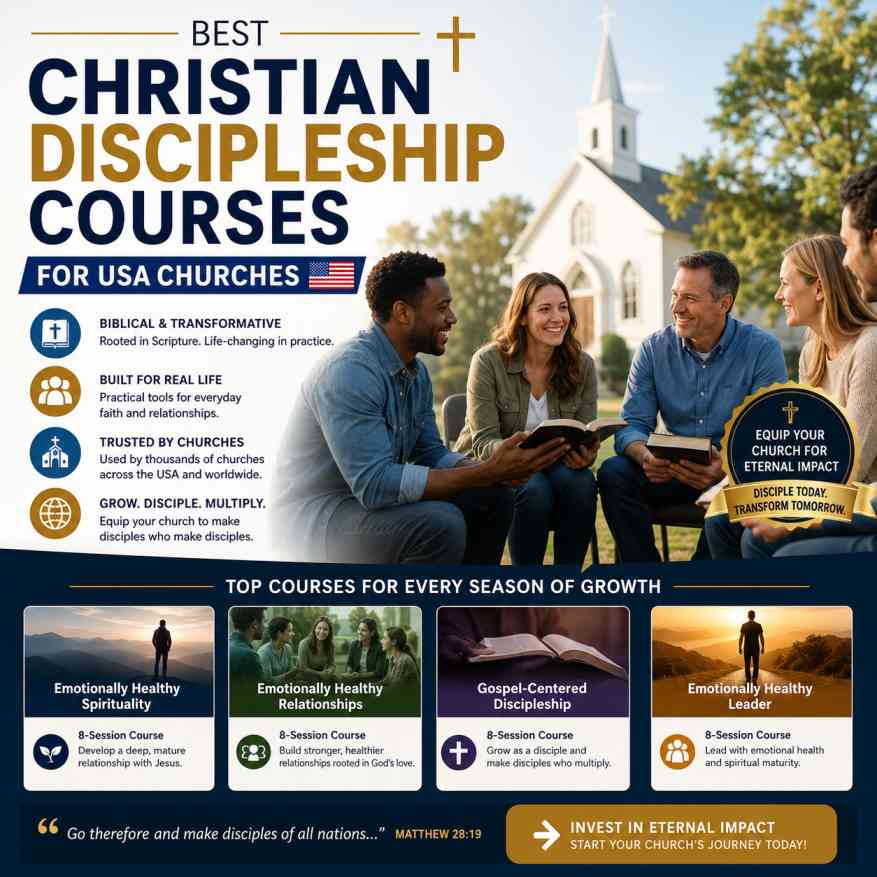
Yes. The EHS Course is Part 1 of the two-part Emotionally Healthy Discipleship Course. Part 2 is the Emotionally Healthy Relationships (EHR) Course — also 8 sessions — which equips participants with 8 practical relationship skills to love others the way Jesus taught. Part 1 focuses on your inner life and relationship with God; Part 2 applies those foundations to your relationships with others.
The Participant’s Pack (Expanded Edition) is approximately $39.99–$44.99 on Amazon as of April 2026. The standalone Expanded Workbook with streaming is less expensive for participants who already own the main book. Downloadable videos for churches are available separately at $23.99. Group pricing and leader packs are available through the Emotionally Healthy Discipleship website.
“The Emotionally Healthy Spirituality Course does something rare: it tells American Christians the uncomfortable truth about the gap between spiritual activity and genuine inner transformation — and then gives them a real, 8-week path through it. It’s not comfortable. It’s not passive. But for those ready to do real work on their inner life, it is among the most transformative discipleship experiences available in 2026.”