Brain Waves for Studying:
The Complete Science Guide
Which frequencies actually support focus, memory, and retention — and what you need to know about the study cycle that most guides completely miss.
01The Real Answer Nobody Gives You
Every article about brain waves and studying eventually arrives at the same destination: "Alpha waves are best for studying!" or "Gamma waves help you focus!" and then leaves you nowhere. These statements are not wrong — they're just dangerously incomplete, because they treat studying as a single, uniform activity when it is actually a multi-phase cognitive process that requires different neural states at different moments.
The honest answer to "which brain wave is best for studying?" is: it depends entirely on which phase of learning you're in.
The learning brain doesn't operate in a single state. It transitions through a sequence of states over hours and days, each one making the next possible. If you only optimise for one — say, forcing yourself into a high-focus beta state for six hours straight — you'll likely impair the very memory consolidation that makes studying worthwhile. Understanding the full cycle is the real advantage.
02The Study Cycle — 5 Brain States That Work Together
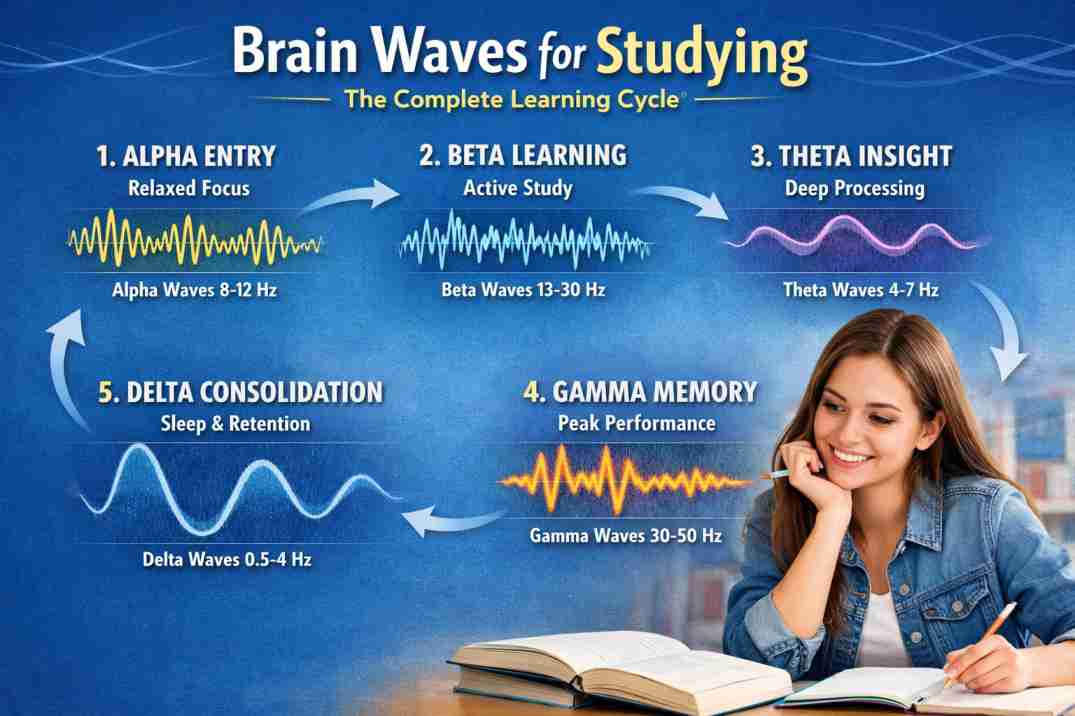
Here is the framework that this entire guide is built around. Each phase of effective studying corresponds to a specific brainwave state, and each state serves a non-substitutable function in the learning process:
The brain state that bridges everyday stress and focused study. Alpha allows information to flow more easily from working memory toward long-term storage and signals the brain's readiness to receive new input. It is the access point, not the destination.
✓ Activate Before StudyingThe dominant frequency during active cognitive engagement. Beta drives your ability to concentrate, process sequential information, analyse problems, and maintain mental goals. It is the workhorse of the study session — but only after alpha has opened the door.
✓ Active During Focused StudyThe brainwave most directly associated with memory formation in the hippocampus. Theta appears during relaxed reflection after learning, creative problem-solving, and light sleep. Individuals with stronger theta during learning tasks show 40–60% improved retention rates compared to those with minimal theta activation.
✓ Post-Study Reflection & Sleep EntryThe fastest measurable brainwave, associated with high-level cognitive binding — where the brain connects new material to existing knowledge across multiple regions simultaneously. Gamma-theta coupling is the neural signature of effective memory encoding. A 40 Hz gamma study found improved memory, cognition, and mood.
→ Complex Material & Deep UnderstandingThis is the most underestimated phase of studying — and it happens while you sleep. During slow-wave sleep (delta), the hippocampus replays newly encoded material and transfers it to permanent cortical storage. Harvard Medical School research showed that individuals with stronger delta sleep activity retained 23% more newly learned information than those who were sleep-deprived.
⚡ Critical — Do Not Skip SleepEffective studying is not about maximising any single brain state. It is about moving through all five states in the right sequence: Alpha entry → Beta encoding → Theta reflection → Gamma integration → Delta consolidation. Skipping any stage — particularly sleep — breaks the chain and degrades retention regardless of how hard you studied.
03Alpha Waves (8–12 Hz) — Your Study Entry Point
Alpha waves are frequently described as "the best brain waves for studying" — and while that's an oversimplification, they do play a uniquely important role that most students completely undervalue: alpha is the transition state that allows you to study effectively in the first place.
Most students sit down to study while still in high-beta mode from their previous activity — scrolling, a stressful commute, a difficult conversation. Their brain is still "noisy." In this state, new information competes with residual activation, working memory is partially occupied, and the brain's natural signal-to-noise ratio is impaired. Alpha clears that noise.
What the Research Actually Shows
A 2025 Scientific Reports study by Rueda-Castro et al. measured EEG data from students in face-to-face, virtual reality, and online learning settings. It confirmed that alpha wave activity was significantly modulated by the quality of social and environmental stimuli during learning — and that students in higher-engagement environments showed brain-to-brain alpha synchrony that correlated with better learning outcomes. This is not metaphor: when you and a teacher or study partner are genuinely engaged, your alpha rhythms partially synchronise, and learning improves measurably.
Alpha at 10 Hz has been specifically identified as the brain's "active intelligence" frequency. Individuals with deficiencies of 13 Hz activity in specific regions consistently show impaired ability to perform sequencing tasks and mathematical calculations. Alpha coherence — meaning how consistently alpha is maintained across the brain — is associated with improved mood, emotional regulation, and crucially, the creative flexibility needed for conceptual understanding.
Close your eyes for 2–5 minutes and focus on slow, rhythmic breathing before you open your notes. Take a short 10-minute walk. Avoid screens for at least 15 minutes before a study session. Listen to instrumental music at a steady, calm tempo. These simple practices shift the brain from high-beta reactive mode into the alpha access state — and they take less than 10 minutes. That time is not wasted; it makes everything after it more efficient.
04Beta Waves (12–20 Hz) — Active Encoding and Focus
Once alpha has prepared the cognitive ground, beta takes over as the dominant frequency for the active work of studying. Beta waves — particularly in the low-to-mid range of 12–20 Hz — are the brain's working state for reading, analysing, problem-solving, and maintaining mental goals against distraction.
MIT neuroscientist Earl Miller's research has shown that beta bursts serve as a cognitive gating mechanism — they regulate which information enters and exits working memory, suppressing distraction so you can hold onto the current task. Every time you resist the urge to check your phone and return to your textbook, a beta burst is partly responsible for that act of cognitive control.
Beta and Studying: What to Know
The relationship between beta and studying has one critical caveat: too much high-beta (20–30 Hz) impairs rather than helps studying. Students who study under conditions of chronic stress, anxiety, or sleep deprivation show elevated high-beta activity that actually interferes with information encoding. The anxious brain is not an efficient learning brain. It processes the threat signal rather than the study material.
The optimal state for active studying combines low-to-mid beta (12–20 Hz) with a background of alpha — a state sometimes described as "relaxed alertness" or "focused calm." This is the state associated with flow, with deep reading, with the feeling that information is "going in" without effort.
05Theta Waves (4–8 Hz) — The Memory Architect
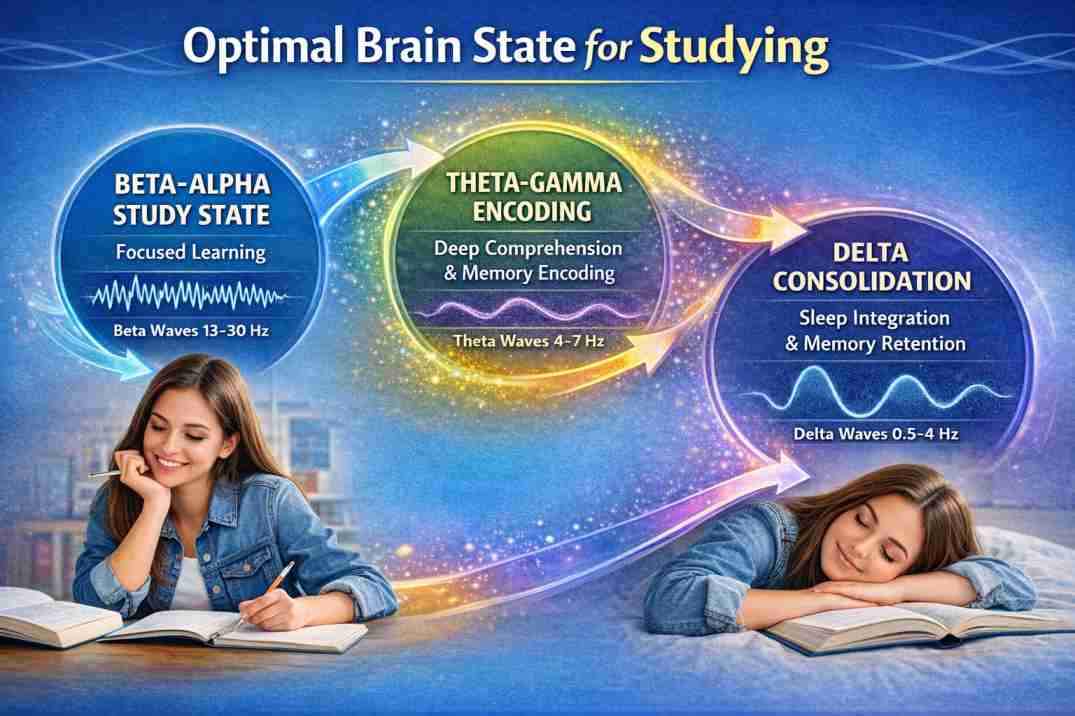
If there is one brainwave that studying guides most consistently underestimate, it is theta. While alpha gets credit for relaxation and beta for focus, theta is doing the actual work of building lasting memories — and it does that work in two separate contexts: during the reflective periods after studying, and during sleep.
The hippocampus — your brain's primary memory formation structure — generates the most robust theta rhythms of any brain region. Research demonstrates that hippocampal theta activity increases by 300–400% during successful memory formation compared to baseline states. This is not a small effect. Theta is not merely associated with memory; it is the neurological mechanism through which memory is constructed.
Theta-Gamma Coupling: The Signature of Effective Learning
The most significant recent development in learning neuroscience is the identification of theta-gamma coupling as the neural signature of effective memory encoding. During this coupling, gamma waves (30–100 Hz) ride on top of theta oscillations (4–8 Hz), with each gamma cycle responsible for holding a discrete piece of information while theta organises and sequences those pieces into a coherent memory structure.
Think of it this way: theta is the filing cabinet; gamma is the individual files being placed inside. When both are working in synchrony, new information gets filed correctly and is retrievable later. When the brain is stressed, fatigued, or overstimulated, this coupling breaks down — and material that seemed learned during the session doesn't survive the night.
NIH-Published Research: Theta Entrainment and Memory
A study published through the NIH directly tested whether artificially boosting theta waves could improve memory. Participants studied a list of 200 words, then either received theta-range audio-visual entrainment, beta-range entrainment, or white noise during a 36-minute window before a memory test. Those in the theta entrainment group consistently outperformed both the beta entrainment and white noise groups on memory recall — confirming that theta is not merely a correlate of good memory, but plays a causal role in its formation.
Separately, a sleep study on Targeted Memory Reactivation (TMR) published in PMC found that replaying classical music cues during slow-wave sleep produced an 18% improvement on knowledge transfer items and increased the probability of test passage. Greater frontal theta activity during slow-wave sleep was predictive of retention even at a 9-month follow-up — the most durable memory effect reported in recent literature.
06Gamma Waves (30–100 Hz) — Integration and Insight
Gamma waves are the speed demons of the brainwave spectrum, and they carry a function that is genuinely distinct from every other frequency band: they bind information together across different brain regions simultaneously. When you suddenly understand how everything connects — when a concept you've been struggling with clicks into place — gamma waves are the neurological event underlying that experience.
For studying, gamma is most relevant for complex, multi-domain subjects where you need to connect new material to prior knowledge — subjects like medicine, law, philosophy, advanced mathematics, or any field where isolated facts are less useful than integrated frameworks. Gamma activity is what allows the brain to see patterns, draw analogies, and build the kind of knowledge architecture that survives exams and real-world application.
What the Research Says About Gamma and Learning
A small study published in the Sleep Foundation's research overview found that people listening to binaural beats at 40 Hz gamma frequency experienced improved memory, cognition, and mood. Stanford's 2025 imaging research also revealed a previously unknown property of theta waves — that they can travel backward through the brain as well as forward, potentially functioning like a backpropagation mechanism similar to those used in AI neural networks. Researchers theorise this directional flexibility plays a role in how gamma-theta coupling actually organises long-term memory.
Gamma waves are most naturally generated during states of deep engagement, active cognitive challenge, and — notably — deep meditation. They are not a passive state. Trying to "study in gamma mode" by playing gamma binaural beats as background music while passively reading is not supported by the evidence. Gamma is best accessed through genuinely demanding cognitive activity: working through difficult problems, teaching material to someone else, or engaging in focused discussion of complex ideas.
07Delta Waves and Sleep — The Phase Students Skip at Their Peril
Here is the part of the brain-waves-for-studying conversation that most content ignores entirely, because it doesn't involve a clever technique or a product to buy: delta waves during sleep are the single most important brainwave event for the studying you did today.
During slow-wave sleep (SWS), characterised by delta oscillations (0.5–4 Hz), the hippocampus systematically replays the day's encoded memories and transfers them to long-term cortical storage. This process cannot be accelerated, cannot be skipped, and cannot be effectively simulated. It requires 7–9 hours of quality sleep, and it begins in earnest in the deep sleep cycles of the first half of the night.
The Harvard Medical School Finding
Research conducted at Harvard Medical School demonstrated that individuals with stronger delta activity during sleep showed 23% better retention of newly learned information compared to those with weaker slow-wave sleep. This is a substantial effect — roughly the difference between a B and an A on a typical exam, achieved not by studying more but by sleeping better.
The Consolidation Timeline
| Time After Learning | Brain Activity | What's Happening | Practical Implication |
|---|---|---|---|
| 0–6 hours | Theta-gamma coupling active | Initial memory stabilisation — new memories are fragile | Avoid stress, don't cram new material |
| 6–24 hours | Delta slow-wave sleep | Hippocampal replay transfers to long-term cortex | Sleep is mandatory — not optional |
| 24–72 hours | Cortical-hippocampal dialogue | Memory traces strengthen and become more resistant to interference | First spaced repetition review window |
| Beyond 72 hours | Distributed cortical storage | Consolidated memories resist forgetting — available for long-term use | Second spaced repetition review window |
Pulling an all-nighter before an exam is one of the worst things you can do for memory retention from the perspective of brainwave science. You skip the delta consolidation phase entirely. Any material encoded the night before is in a fragile, pre-consolidated state — vulnerable to interference and highly likely to be unavailable under exam stress. Study earlier, sleep well, review briefly the next morning. The neuroscience is unambiguous on this.
08Step-by-Step: How to Optimise Every Study Session
This is the practical application of everything above — a sequence you can actually implement. These steps follow the natural brainwave cycle of effective learning, not a productivity framework or a motivational system:
095 Common Myths About Brain Waves and Studying
This field attracts a lot of misleading content. Here are the five most persistent misconceptions, corrected by what the research actually shows:
10Do Binaural Beats Actually Work for Studying?
This is the question that brings most people to this topic, so it deserves a genuinely honest answer rather than a promotional one. Here is what the current research shows, without exaggeration in either direction:
| Frequency | Study Finding | Evidence Level | Best Use Case |
|---|---|---|---|
| Theta (4–8 Hz) | NIH study: theta AVE improved memory recall vs. beta AVE and white noise | Moderate — Lab Confirmed | Pre-study relaxation, post-study reflection |
| Alpha (8–12 Hz) | Associated with increased creativity and relaxed focus; 15 Hz improved visuospatial WM accuracy | Moderate — Lab Confirmed | Pre-study transition, creative work |
| Beta (12–20 Hz) | 15 Hz improved working memory task response accuracy and cortical network strength | Moderate — Some Support | Focused active study sessions |
| Gamma (40 Hz) | 40 Hz improved memory, cognition, and mood in small study; EEG entrainment confirmed | Emerging — Small Studies | Complex material, integrative review |
| During Active Testing | 2023 study of 1,000 people: binaural beats slightly impaired test scores vs. silence | Caution — Avoid During Tests | Do NOT use during exams or active recall |
Binaural beats are a legitimate tool with genuine but modest and context-dependent effects. They are not a substitute for good sleep, spaced repetition, or retrieval practice. The most evidence-supported use: theta-range beats (5–7 Hz) during a 10-minute wind-down before studying to transition into alpha-beta readiness; and during post-study reflection periods to support theta encoding. Use them as preparation tools, not as study companions. And never during active testing, recall practice, or reading — the 1,000-person study's finding should be taken seriously.
11Frequently Asked Questions
Your Brain Already Knows How to Learn — Let It
The neuroscience of brain waves and studying ultimately points to the same conclusion that effective educators have always suspected: the brain learns best when it is calm, focused, and well-rested — not when it is exhausted, stressed, and running on caffeine at midnight. Alpha, beta, theta, gamma, and delta are not tricks to hack. They are the natural architecture of learning. Honour that architecture, and studying stops being a battle and starts being a process.