How to Meditate Daily —
The Guide That Actually Works
You don't need silence, a special room, or 45 minutes. You need 5 minutes, a clear method, and the truth about what meditation actually is.
Section 01What Meditation Really Is — And What It Isn't
Before you spend another hour reading about meditation without actually doing it, let's establish one thing clearly: meditation is not about emptying your mind. That belief is the single most common reason people quit before they ever see results. They sit down, notice they're thinking about their grocery list, and conclude they're doing it wrong.
They're not doing it wrong. That noticing is the practice.
Think of it like this: your brain generates thoughts the way your heart generates beats. You cannot stop it — you're not supposed to. What you can train is how you respond to those thoughts. Do they carry you away for five minutes before you notice? Or do you catch the wandering in ten seconds and return? That returning — that noticing and redirecting — is the entire practice. Every single time you do it, you're doing a repetition.

Meditating in soft morning light
This reframe matters practically. A 2021 study on meditation dropout found that 67% of people who quit cited "feeling like they were failing" as the primary reason — not lack of time, not lack of interest. They thought a wandering mind meant failure. It doesn't. It means you're human, and you're practicing exactly right.
Section 02What the Science Actually Says in 2026
The research on daily meditation has grown significantly over the past decade. As of 2026, we have peer-reviewed studies with measurable outcomes across thousands of participants. Here is what the data shows — no exaggeration, no omissions:
| Outcome | Research Finding | Source |
|---|---|---|
| Stress Hormone (Cortisol) | Just 2 min/day reduced cortisol by 15–20% over 30 days | 2019 Peer-Reviewed |
| Attention & Memory | 13 min daily enhanced both after just 8 weeks | PubMed 2019 |
| Anxiety Reduction | Comparable to antidepressants for mild-to-moderate cases | JAMA Internal Med |
| Brain Structure | 8 weeks increases gray matter in prefrontal cortex | Harvard / MIT Study |
| Sleep Quality | 50% of insomnia patients who meditate fall asleep faster | Harvard Medical |
| Blood Pressure | Reduces systolic BP by 5–10 mmHg consistently | NIH Research |
| Large-Scale Stress | Study of 3,500 adults confirmed significant stress reduction | Meta-Analysis |
Every benefit above requires daily consistency, not session length. 5 minutes every day for 8 weeks produces measurably better outcomes than 30-minute sessions twice a week. Build the habit first. The length comes second.
Section 034 Types of Meditation That Work for Beginners
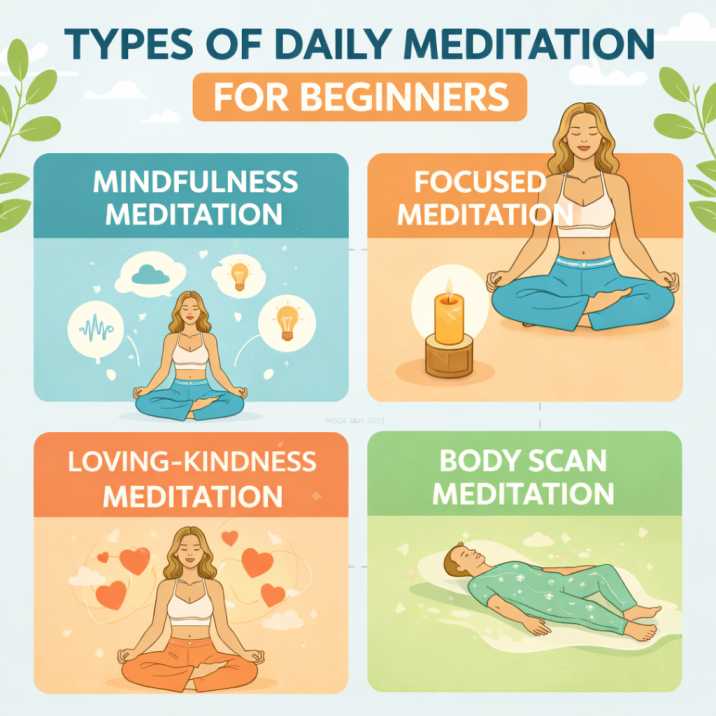
There are dozens of meditation styles. Most beginners don't need to know all of them — they need the four with the highest success rate for people starting from zero. Pick one. Commit to it for 30 days before experimenting with others.
1. Breath-Focused Meditation (Most Recommended)
Sit comfortably. Focus on the physical sensation of breathing — the air entering your nostrils, your chest or belly rising and falling. When your mind wanders (it will), gently bring attention back to the breath. That's it. This is the foundation of most secular mindfulness traditions and is the most widely studied form of meditation worldwide.
2. Counting Meditation (For Analytical Minds)
Inhale — count "one." Exhale — count "two." Continue to ten, then restart. When you lose count, start again at one without judgment. The counting gives your analytical brain a task, reducing mental noise enough for awareness to settle. Excellent for people who find pure breath focus too abstract at first.
3. Guided Meditation (Zero Prior Experience Needed)
Follow a teacher's voice through a structured session. Apps like Headspace, Calm, and Insight Timer offer thousands of guided sessions. Research using the Headspace app found measurable improvements in compassion and stress markers among regular users. The advantage: you don't have to manage your own experience while still learning what meditation feels like.
4. Body Scan (Best for Anxiety and Sleep Issues)
Systematically direct your attention from your head to your toes, noticing physical sensations at each point without trying to change them. Particularly effective for people who hold stress physically — tight shoulders, jaw tension, shallow breathing. A 10-minute body scan before sleep is one of the most evidence-backed tools for improving sleep quality available to you right now, for free.
Section 04Step-by-Step: How to Start Meditating Daily Today
This is the part most guides bury under pages of philosophy. Here it is — direct and actionable. Follow these six steps exactly for the first two weeks:
Section 05The Best Time to Meditate Daily
Early morning — 5 AM to 7 AM — is the time most supported by evidence. At this hour, cortisol levels are naturally rising, making you alert yet calm. Research from the University of California found morning meditation can reduce stress hormones by up to 25% throughout the entire day — not just during the session.
Midday (noon to 2 PM) is a solid alternative. This window aligns with the natural post-lunch energy dip — meditating here counteracts afternoon fatigue and can measurably boost productivity for the second half of the day. The National Institutes of Health note that a brief midday session can lower blood pressure and combat afternoon anxiety spikes.
Evening meditation (8–10 PM) works best specifically for sleep. Harvard Medical School research shows that evening mindfulness practices improve sleep quality by reducing racing thoughts at bedtime. If insomnia is your primary issue, an evening body scan is the most targeted intervention available.
The best time to meditate is the time you will actually show up for, every single day, without negotiating with yourself. A consistent 6 PM mediator will always outperform an inconsistent 6 AM aspirant. Pick the time that fits your real life — not the life you plan to have.
Section 06What to Expect — Week by Week, Honestly
Nobody tells you what the first month of daily meditation actually feels like. Here's the honest timeline, based on research and real practitioner accounts — including what is hard before it gets good:
Section 075 Mistakes That Kill the Daily Meditation Habit
1. Starting Too Long
Deciding to meditate for 20 minutes on Day 1 is a setup for failure. You haven't built the attention muscle yet. Five minutes of focused, daily practice beats 20 minutes of restless, once-a-week sitting every single time. Start small. Length can grow after the habit is locked in.
2. Grading the Sessions
A session is not better because your mind was quiet, or worse because it was noisy. Sessions are neutral training inputs. Dr. Deepak Chopra notes that "letting go of expectations is a big part of the process." Stop evaluating your sits. You showed up — that is the only metric that counts in month one.
3. No Environmental Cue
Without a trigger, the habit has no anchor. "I'll meditate sometime today" becomes zero meditations per week. Attach it to something that already happens daily: your first coffee, your morning alarm, sitting at your desk before opening email. The cue creates the habit automatically over time.
4. Treating Missed Days as Complete Failure
Missing one day is normal. Missing two in a row is the start of a gap. Never miss three. That is the only rule that matters for habit recovery. A missed day is a pause — not a death sentence — unless you treat it like one and use it as permission to quit entirely.
5. Waiting Until You Feel "Ready"
You will never feel ready to start meditating. Your mind will always feel too noisy to begin. That restless feeling is the exact point of entry, not an obstacle to it. Sit down now. Readiness comes from the act of sitting — not before it.
Section 08Real Pros & Cons of Daily Meditation — Unfiltered
Every wellness publication tells you meditation is transformative. Fewer tell you about the parts that are genuinely hard, slow, or not suited to every person. Here's an honest accounting of both sides:
- Measurable cortisol reduction within 2–4 weeks of consistent daily practice
- Improved focus and working memory — confirmed by multiple peer-reviewed studies
- Requires zero money and as little as 5 minutes per day to begin
- Anxiety reduction comparable to medication for mild-to-moderate cases (JAMA data)
- Significantly improves sleep quality, especially body scan and evening practice
- Builds emotional regulation — you become less reactive in conflict and stress
- Structural brain changes documented after just 8 weeks by MRI measurement
- Long-term practitioners show higher empathy, better memory, and greater self-awareness
- Benefits are slow and subtle — culture expects instant results; early practice rarely delivers them
- The first 2 weeks are frustrating for most beginners; the majority quit before week 3
- For some trauma survivors or severe anxiety sufferers, sitting with thoughts can temporarily increase distress
- It is not a substitute for therapy or medication — it is a complementary practice
- Requires genuine daily consistency for measurable change — occasional sessions produce minimal benefit
- Physical discomfort (legs, back) is a real barrier for floor-seated practice without proper cushion support
- Significant wellness-industry noise — many apps and courses overpromise results
If meditation consistently increases your anxiety rather than reducing it — stop. Some people with trauma histories need a trauma-informed approach before standard mindfulness practice. A mental health professional familiar with mindfulness-based interventions (MBSR, MBCT) can help you find the right entry point.
Section 09Best Products for Daily Meditation — 2026 Buyer's Guide
You genuinely don't need products to meditate. A chair is enough. But if you plan to sit on the floor regularly, physical discomfort is one of the most cited reasons practitioners quit — not philosophy, not commitment, but sore knees and an aching back shifting your focus away from your breath. The right support eliminates that entirely.
The Florensi zafu is the most consistently recommended beginner cushion in 2026 for a simple reason: it balances support with approachability. The buckwheat hull fill contours to your body while maintaining firmness — unlike foam, which compresses within weeks. The foam layer underneath reduces direct pressure on knees and ankles, making longer sessions achievable from day one.
- 100% natural buckwheat hulls — firm, adjustable, breathable fill
- Removable velvet cover, machine-washable
- Hip elevation maintains natural spinal curve
- Foam base layer reduces knee and ankle pressure
- 6,700+ Amazon reviews · 4.5/5 rating
Jon Kabat-Zinn created Mindfulness-Based Stress Reduction at the University of Massachusetts Medical School — the most rigorously studied secular mindfulness program in medical history. This book is not abstract philosophy. It's grounded, human, and practical. Over 12,000 Amazon reviews averaging 4.7 stars. Short chapters make it ideal for reading alongside your daily practice rather than as a separate project.
- Written by the scientist who brought meditation into Western medicine
- Practical, non-spiritual — no prerequisites required
- Short daily chapters complement your sitting practice perfectly
- 12,000+ Amazon reviews · 4.7/5 average rating
If you want proper buckwheat support without spending $60+, the Retrospec Zafu is the most recommended budget cushion of 2026. Ergonomic design tilts hips forward to naturally alleviate lower back tension. 100% buckwheat fill, 100% cotton washable cover, built-in carry handle. Available in both round and crescent shapes. At ~$25 it's the lowest-risk entry point for testing whether floor meditation works for your body before committing to a premium cushion.
- 100% buckwheat fill — adjustable hull quantity
- 100% cotton machine-washable cover with carry handle
- Round (traditional) or crescent (more leg room) shape options
- Best budget entry point for floor meditation beginners
Section 10FAQ — Real Questions, Honest Answers
The Simplest Practice With the Largest Return
Five minutes. A chair. No equipment required. No perfect mental state needed. What daily meditation offers — reduced stress, sharper focus, better sleep, a measurably calmer nervous system — is available to anyone willing to sit down consistently and breathe. The research is clear. The barrier is low. The only obstacle is starting.