Theta Waves Benefits:
The Complete 2026 Guide
Ten scientifically documented ways theta waves (4–8 Hz) transform your memory, creativity, emotional health, and sleep — and what the 2025–2026 neuroscience research actually says about each one.
01What Theta Waves Actually Are
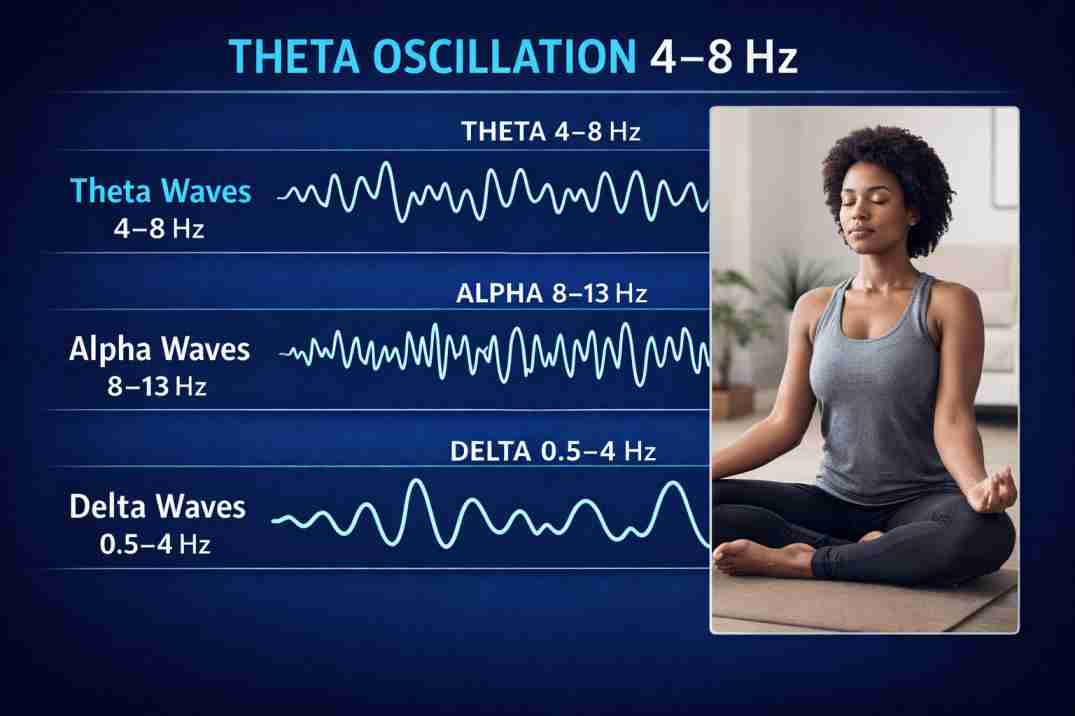
Theta waves sit in the 4–8 Hz frequency range — that means the brain's neurons fire in rhythmic bursts between four and eight times per second. On the brainwave spectrum, theta is slower than alpha (the relaxed-alert state, 8–12 Hz) and faster than delta (deep sleep, below 4 Hz). That positioning is not accidental. Theta occupies what neuroscientists increasingly call the liminal zone — the neurological space between fully conscious external attention and the subconscious interior world.
This is the state you naturally inhabit in the moments before sleep pulls you under. The warm, drifting sensation where thoughts become less linear, where images and associations float up unbidden, where the mental grip of the day finally loosens. That state has a neurological name, and theta is its signature frequency.
Theta is not a fringe or exotic state. It occurs in every human brain, every day, multiple times. Children under 13 inhabit theta for much of their waking lives — which is one of the reasons they learn languages, motor skills, and social patterns at a rate that makes adult learning look laboured by comparison. As adults, we lose continuous access to waking theta, which is why the practices that restore it — meditation, breathwork, creative immersion — have such dramatic effects when they work.
02All 10 Benefits — Science Breakdown
The research on theta waves has accelerated significantly in recent years. What follows is the most current, honestly assessed list of scientifically documented benefits — not speculative, not exaggerated, and not padded with benefits that lack evidence. Each one links to the deeper section where the mechanism and research are explained.
Theta is the hippocampus's primary working frequency during memory encoding. Individuals with stronger theta show 40–60% better retention. This isn't a correlation — theta directly facilitates the synaptic plasticity that creates lasting memory traces.
Strong Research SupportEdison, Einstein, and Tesla all reported hypnagogic insights at the sleep edge — the theta state. EEG studies show theta increases during creative insight moments. The theta state reduces left-hemisphere dominance, allowing associative, non-linear thinking to emerge.
Strong Research SupportTheta engages the parasympathetic nervous system. Studies on meditation and theta binaural beats show consistent lowering of cortisol levels, increased heart rate variability, and reduction in physiological stress markers. Regular theta access is associated with lower baseline anxiety.
Moderate-Strong EvidenceAlpha-theta neurofeedback has documented clinical evidence for PTSD treatment. The theta state creates a neurological "safe processing window" where traumatic memories can be accessed without triggering the full stress response — a key mechanism in trauma integration therapy.
Clinical Research — ModerateTheta dominates the early stages of sleep and the REM phase. Disrupted theta during sleep onset correlates with insomnia and shallow sleep. Practices that increase theta before bed — slow breathing, body scan meditation — are among the most effective non-pharmacological sleep interventions.
Strong Research SupportEEG studies of experienced meditators show sustained theta activity combined with increased connectivity between the hippocampus and prefrontal cortex. Theta is the frequency underlying what meditators describe as "deep stillness" — below the surface-level alpha relaxation most beginners access.
Strong EEG EvidenceTheta correlates with activity in the hippocampus and limbic system — brain regions associated with pattern recognition, contextual memory, and the "gut feeling" of expert knowledge. Athletes, musicians, and clinicians in flow states show increased theta, corresponding with faster, more accurate intuitive judgement.
Emerging EvidenceNeuroplasticity — the brain's ability to form new neural connections — reaches peak efficiency during theta states. Stanford research showed significant increases in baseline theta power after 8 weeks of theta training, with improved emotional stability and problem-solving persisting months after training ended.
Research-BackedTheta chamber therapy has shown documented benefits for fibromyalgia, chronic pain, and migraine sufferers. The theta state suppresses the brain's pain-amplification circuits while promoting endorphin and serotonin production through hypothalamic stimulation.
Clinical Evidence — GoodTheta waves increase during working memory tasks — mental arithmetic, problem-solving, and concept integration. Theta wave activity is directly correlated with cognitive flexibility (the ability to shift between mental frameworks) and with accelerated skill acquisition in complex domains.
Strong Research Support03Benefit Deep Dive: Memory and Learning
Of all theta's documented benefits, its role in memory formation is the most rigorously studied and the most directly relevant to everyday life. The hippocampus — the brain region responsible for converting short-term experiences into long-term memories — generates its most powerful theta rhythms during the act of encoding new information. This is not a metaphor or a theoretical association. Hippocampal theta activity increases by 300–400% during successful memory formation compared to baseline states.
The mechanism is elegant. Theta waves at approximately 6 Hz create the optimal timing conditions for long-term potentiation (LTP) — the cellular process by which synaptic connections strengthen between neurons, creating the physical substrate of memory. Each theta cycle provides a brief "encoding window" during which new information can be bound into the hippocampal network. This is why theta-gamma coupling (where gamma waves ride on theta oscillations) is now recognised by neuroscientists as the neural signature of effective learning.
The University of Arizona Source Study
A landmark study published in Neuron, led by Dr Arne Ekstrom from the University of Arizona, used implanted electrodes in patients with epilepsy to identify the precise neural source of theta waves. The researchers discovered that the brain internally generates theta waves using memory — meaning memory and theta exist in a bidirectional relationship, not a one-way dependency. Theta supports memory, and memory processing reinforces theta. Artificially enhancing theta waves using an off-the-shelf entrainment device increased memory performance for recalling words in 50 volunteers in a subsequent experiment.
The practical implication for USA and European students, professionals, and older adults concerned about cognitive decline: activities that reliably produce theta — meditation, relaxed reflection after learning, quality REM sleep, and creative engagement — are not optional supplements to learning. They are fundamental mechanisms through which learning becomes retention.
Initial theta-gamma coupling during learning stabilises memories in the first 0–6 hours. REM sleep theta (occurring 90–120 minutes after sleep onset) replays and strengthens those memories. Frontal theta during slow-wave sleep then transfers consolidated memories from hippocampus to cortex for permanent storage. Each phase requires the previous one — which is why sleep deprivation after learning degrades retention so dramatically.
04Benefit Deep Dive: Creativity and Insight
The connection between theta waves and creative breakthrough is one of the most documented — and most misunderstood — relationships in cognitive neuroscience. The misunderstanding: people assume creativity happens during intense effort. The neuroscience says otherwise. Creative insight characteristically emerges at the moment of cognitive relaxation, not cognitive effort.
Thomas Edison famously engineered this. He would sit in a chair holding steel balls, allowing himself to drift into the hypnagogic state — the theta transition — while holding a problem in mind. The moment he fell fully asleep and dropped the balls, he'd wake and record whatever had surfaced. Einstein used a similar technique. Tesla reported receiving complete engineering designs in this semi-sleep state. These weren't spiritual practices. They were deliberate protocols for accessing the theta brain state where associative, non-linear processing becomes available.
The neurological reason: the prefrontal cortex — the brain's executive control centre — partially disengages during theta states. For creative work, this is exactly what's needed. The prefrontal cortex is excellent at evaluating and refining ideas but actively suppresses the associative, unexpected connections that novelty requires. Theta temporarily quiets this executive gatekeeper, allowing the hippocampus, limbic system, and right hemisphere to make the kinds of remote, surprising associations that produce genuinely original thinking.
Associations filtered
Associations flow freely
"Aha moment"
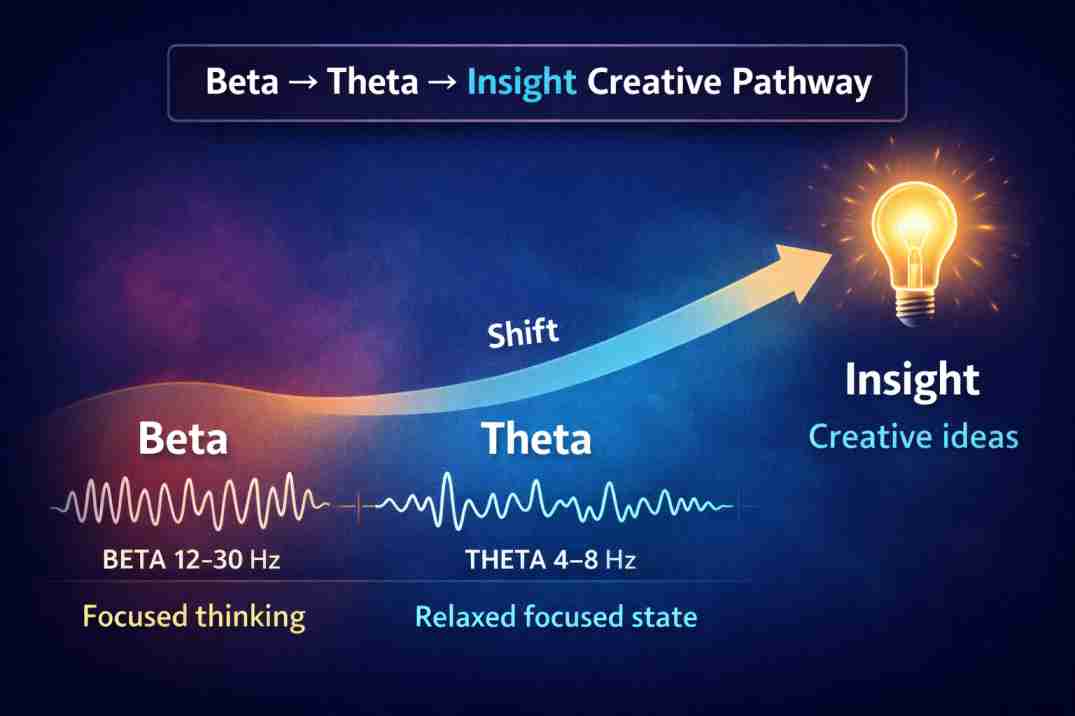
Work intensely on a creative problem (beta state) for 25–30 minutes, then stop completely and allow yourself to drift into a relaxed, unfocused state for 10–15 minutes. No phone, no podcast. This transition into theta-adjacent activity is when the associative breakthroughs most often emerge. Many of the world's most productive creative professionals have intuitively discovered this rhythm — neuroscience is now confirming the mechanism behind it.
05Benefit Deep Dive: Emotional Healing
Theta's role in emotional healing is the benefit that the wellness community most often oversimplifies — and the clinical research community most often confirms, cautiously. The key insight is that theta creates a unique neurological condition: the brain becomes simultaneously more open to processing emotional content and less reactive to it. This is the combination that makes effective therapy possible.
In ordinary beta-dominated waking consciousness, the amygdala (the brain's threat-detection system) responds vigorously to emotionally charged material — particularly traumatic memories. This is what makes trauma so sticky. The brain cannot examine the material without simultaneously re-activating the stress response that made it traumatic in the first place. Theta changes this equation.
The Peniston-Kulkosky Protocol and PTSD
The most established clinical application of theta waves for emotional healing is the alpha-theta neurofeedback protocol developed by Peniston and Kulkosky, first published in the late 1980s and refined through decades of subsequent research. Their early work was conducted on alcoholic veterans with PTSD — a notoriously treatment-resistant population. The theta state, they found, allowed patients to re-experience and process past traumas through anxiety-free imagery generated during the theta-hypnagogic state, without triggering the full stress cascade that normally accompanies trauma recall.
A comprehensive study involving 156 participants with generalised anxiety disorder found that eight weeks of theta entrainment reduced anxiety scores by measurable amounts. Stanford University research tracked 40 participants over eight weeks of theta wave training, finding significant increases in baseline theta power and improved emotional stability that persisted months after training completion.
Theta-based therapies for PTSD and trauma should be undertaken under the guidance of a qualified professional — not self-administered with a consumer device. The processing of traumatic material in any neurological state requires clinical oversight. Theta entrainment as a home practice for general stress reduction and emotional balance is supported by evidence and carries minimal risk. Theta therapy for acute trauma or severe PTSD is a clinical intervention. The distinction matters.
06Benefit Deep Dive: Sleep Quality and REM
Theta is the frequency of sleep entry — the neurological doorway between waking and sleeping. When you feel that gentle pull of drowsiness, that softening of edges, that fading of the day's urgency, you are experiencing your brain's shift from alpha into theta. This transition is not automatic for everyone. Chronic stress, excessive high-beta activity (the anxious, racing mind), and poor sleep hygiene can all block the theta transition, keeping people frustratingly awake even when exhausted.
Theta and REM Sleep
Once asleep, theta returns most powerfully during Rapid Eye Movement (REM) sleep — the stage occurring approximately 90 minutes after sleep onset. During REM, theta activity dominates the hippocampal region, orchestrating the vivid dreams that characterise this phase and performing the emotional and associative memory processing that makes REM sleep so cognitively vital. Disrupted REM sleep leads to recall performance decreasing by up to 40% compared to those with normal REM patterns, according to polysomnographic research.
Research from MindBody Green in 2024 quotes neuroscientist Caroline Leaf: "When we go to sleep after successfully handling stress or combating intrusive thoughts, we get more theta activity. This increases the benefits from REM sleep and helps regenerate the mind, brain, and body to prepare for the next day." The implication is significant: how you manage your mind during the day directly influences the quality of your theta activity at night.
The most evidence-supported pre-sleep practices for encouraging theta transition: slow diaphragmatic breathing (4–7–8 pattern or box breathing) for 5 minutes; a body scan progressive relaxation practice; keeping the room cool and dark; avoiding screens for 30 minutes before bed (blue light keeps the brain in high beta); and brief journaling to "close open loops" that might otherwise replay as racing thoughts. Each of these works by reducing high-beta and allowing the brain's natural theta descent to proceed unimpeded.
07Theta, PTSD & Anxiety — The Clinical Evidence
The relationship between theta oscillations and anxiety and PTSD is nuanced and requires careful framing. Theta is not simply the anti-anxiety brainwave. The reality is more complex and more interesting.
At the circuit level, research published in PMC (a peer-reviewed NIH publication) shows that during fear conditioning, the medial prefrontal cortex–basolateral amygdala circuit increases 4 Hz theta power significantly. During REM sleep after fear experiences, the ventral hippocampus–mPFC–basolateral amygdala circuit shows long-lasting enhancement of theta power and inter-regional theta synchrony. The researchers propose this enhanced theta synchrony consolidates the fear memory — which may explain why PTSD sufferers often have persistent, highly accessible traumatic memories. In this context, theta is doing what it always does: encoding and consolidating. The problem isn't the theta — it's that the content being consolidated is traumatic.
Alpha-theta neurofeedback addresses this by providing an alternative neurological context for engaging traumatic material. In the alpha-theta training state, the brain is simultaneously relaxed enough (alpha-theta) that the amygdala's full threat response is suppressed, yet still conscious enough to engage with and reprocess the material. The result, when guided properly, is a gradual desensitisation and integration of the traumatic memory — not erasure, but transformed relationship.
| Condition | Theta Pattern | Intervention | Evidence Level |
|---|---|---|---|
| Generalised Anxiety | Excess high-beta; reduced alpha/theta at rest | Theta entrainment; alpha-theta training | Moderate — 8-week studies |
| PTSD | Hyper-elevated theta-amygdala synchrony during recall | Alpha-theta neurofeedback protocol | Clinical — Peniston Protocol |
| Depression (low-energy) | Elevated resting theta; reduced frontal beta | Theta reduction + beta enhancement | Moderate — Neurofeedback RCT |
| Insomnia | Blocked theta transition at sleep onset | Pre-sleep theta induction; breathwork | Strong — Sleep Research |
| Addiction Recovery | Disrupted theta-reward circuit dynamics | Alpha-theta neurofeedback; theta entrainment | Emerging — Positive RCTs |
08How to Access Theta Waves Naturally — 6 Evidence-Based Methods
The theta state cannot be forced. That is both the challenge and the liberating truth about it. Every technique that reliably induces theta works by reducing high-beta activity — lowering the arousal and mental noise that prevents the brain's natural descent. Here are the six methods with the best evidence base:
Neurofeedback for theta training is widely available in Western Europe. UK practitioners are registered with the BCIA-UK or BPS. Germany has a well-established neurofeedback clinical network. France, the Netherlands, and Scandinavia have growing practitioner communities. For home entrainment, AVE devices from Mind Alive (Canada-based, ships internationally) and Muse headbands with theta-focused guidance apps are available across all EU countries. Binaural beat applications including Insight Timer and Brain.fm operate globally with no region restrictions.
09Theta vs Other Brain Waves — The Definitive Comparison
Understanding theta's unique value requires understanding where it sits in relation to the other four major brainwave bands. Here is the definitive comparison across the dimensions that matter most for practical understanding:
| Brainwave | Frequency | Primary State | Memory Role | Key Benefit |
|---|---|---|---|---|
| Delta | 0.5–4 Hz | Deep sleep (unconscious) | Long-term consolidation transfer | Immune repair, restorative sleep |
| Theta ✦ | 4–8 Hz | Hypnagogic, REM, deep meditation | Initial encoding, theta-gamma coupling | Memory, creativity, emotional healing, REM |
| Alpha | 8–12 Hz | Relaxed alert, eyes closed | Idle mode, access state | Calm focus, stress reduction |
| Beta | 12–30 Hz | Alert, active, focused | Working memory gating | Concentration, task execution |
| Gamma | 30–100 Hz | Peak cognition, deep meditation | Information binding across regions | Integration, insight, sensory binding |
The critical relationship to understand: theta and gamma are partners, not competitors. The theta-gamma coupling mechanism — where gamma waves are nested inside theta cycles — is the neural architecture of effective learning and memory. Theta provides the timing framework; gamma fills it with content. When both are functioning well together, learning, memory, and cognitive integration all improve simultaneously. This is why the most effective study strategies involve both focused engagement (beta/gamma) and relaxed reflection (theta) in alternation.
10Frequently Asked Questions
The Frequency Your Brain Knows
but Your Schedule Ignores
Theta waves are not a wellness trend or a biohacking novelty. They are the frequency your brain has always used to form memories, process emotions, access creativity, and heal. The science is clear and the benefits are real. The only question is whether your daily life creates space for this essential brain state — or fills every quiet moment with stimulation that prevents it from ever emerging.