Where to Put Lavender Oil
for Anxiety — 7 Proven Spots
Backed by Real Science
31.1% of people experience an anxiety disorder in their lifetime. Lavender oil is the world's largest OTC complementary medicine for mood — and where you apply it determines how fast and how deeply it works. Here are the 7 placements that clinical research and real buyers confirm.
The 3 Best Placements — If You Only Read This Far
Wrists (pulse points): Body heat continuously volatilizes the oil molecules upward toward your face. Every movement of your hands brings diluted lavender molecules to your nose — sustained, automatic, all-day conditioning of the nervous system.
Temples: Thin, well-vascularized skin with direct proximity to the limbic system via the temporal pathway. Apply diluted lavender oil here for fast absorption and continuous inhalation during meditation, reading, or sleep.
Diffuser — whole room: For anxiety that isn't situational, ambient diffusion conditions the nervous system over time. Run 5–7 drops in 300ml water for 30–60 minutes during peak anxiety hours, or all night for sleep-linked anxiety. This is the method with the strongest clinical evidence base across 11 studies and 972 participants.
Why Lavender Actually Works — Real Mechanism, Not Magic
Lavender has more clinical evidence for anxiety reduction than any other essential oil — making it exceptional in a field where most claims are unsupported. The primary active compounds are linalool and linalyl acetate, two terpenoids that pharmacologically inhibit voltage-gated calcium channels, reduce 5HT1A serotonin receptor activity, and increase parasympathetic tone. The result is a chemical cascade that mimics benzodiazepine action — without the dependence potential.
Woelk & Schläfke (2010), RCT: Oral Silexan (80mg standardized lavender oil capsules) showed equivalent efficacy to lorazepam 0.5mg/day in 77 generalized anxiety disorder patients over 6 weeks — without sedation or dependence potential.
PMC Systematic Review (2023): 11 inhalation studies, 972 participants — 10 of 11 reported significantly decreased anxiety after lavender oil inhalation. Physiological measures (heart rate, blood pressure, respiratory rate) confirmed reduction.
Kasper et al. (2014), RCT: 539 generalized anxiety disorder patients. Silexan outperformed placebo and showed effects comparable to paroxetine (20mg) — a first-line SSRI.
ScienceDirect Network Meta-Analysis (2020): Lavender aromatherapy is clinically superior for short-duration anxiety relief. Oral Silexan 80mg is preferable for long-term treatment.
The olfactory pathway is why placement matters so much. When you inhale lavender molecules, they reach the olfactory bulb — which has direct limbic inputs to the amygdala and hippocampus, the brain's emotional processing centers. This pathway bypasses the conscious cortex, which is why lavender can produce a calming effect even when you are actively anxious and consciously "know" the anxiety is irrational. The amygdala responds to olfactory input before the cortex processes it.
This explains why placement on pulse points, temples, and under the nose produces faster results than other body locations — maximizing the concentration of inhaled molecules reaching the olfactory bulb is the primary mechanism.
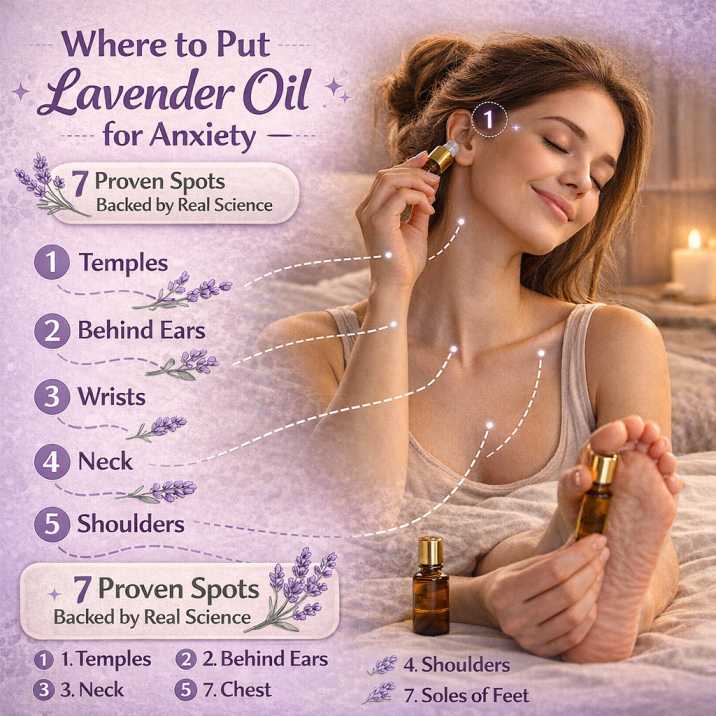
7 Proven Placements — Where to Put Lavender Oil for Anxiety
Always dilute lavender oil in a carrier oil before skin application. The correct ratio for adults is 2% dilution: approximately 3 drops per 1 teaspoon (5ml) of carrier oil. Carrier oil options: jojoba, fractionated coconut, sweet almond, or rosehip. Never apply undiluted essential oil for extended topical use — even lavender, the gentlest essential oil, can cause skin sensitization over time.
📸 Replace with a clean illustrated body diagram with color-coded dots — high Bing Visual Search ranking for "where to apply lavender oil" queries
Fast, Sustained or Ambient — Choose Your Method
📸 Replace with a lifestyle triptych — hand cupping bottle + wrist application + diffuser mist — top search image for aromatherapy how-to queries
Apply diluted lavender to wrists and temples (topical anchor) → Start the diffuser in your workspace or bedroom (ambient conditioning) → When anxiety peaks, bring wrists to nose and take 5 slow breaths using the 4-count inhale / 6-count exhale technique. The slow extended exhale independently activates the parasympathetic nervous system. Lavender amplifies this effect. The combination of physiological breathing technique + olfactory limbic activation + ambient conditioning is the most clinically coherent anxiety protocol available without prescription.
Lavender Oil Dilution Guide — Exact Ratios for Every User
Essential oils are highly concentrated botanical extracts. Lavender is the gentlest of all essential oils — but prolonged undiluted topical use can still cause skin sensitization over time. Always use a carrier oil for skin application. Dilution does not reduce effectiveness — it increases absorption area and extends duration.
Always patch test first: Apply diluted oil to inner forearm, wait 24 hours, check for redness or irritation before broader use.
Medication interactions: Lavender may lower blood pressure — consult a doctor before use if you take hypertension medications (captopril, enalapril, losartan). May also interact with other CNS-affecting substances.
Pregnancy / breastfeeding: Consult a healthcare professional before use. Lavender in moderation is generally considered safe but individual responses vary.
Pure oil only: Use only Lavandula angustifolia (true lavender) — not synthetic fragrance oils, lavandin (Lavandula x intermedia), or spike lavender (Lavandula latifolia). Only true lavender has the linalool:linalyl acetate ratio used in clinical research.
How to Use a Diffuser for Lavender Anxiety Relief — The Right Setup
Lavender
Oil
Water
300ml
Diffuser
21dB
Setting
1–8hr
Nervous
System
📸 Replace with a styled diffuser + lavender oil bottle + soft lighting flat-lay — top Bing image result opportunity for "lavender oil diffuser anxiety" searches
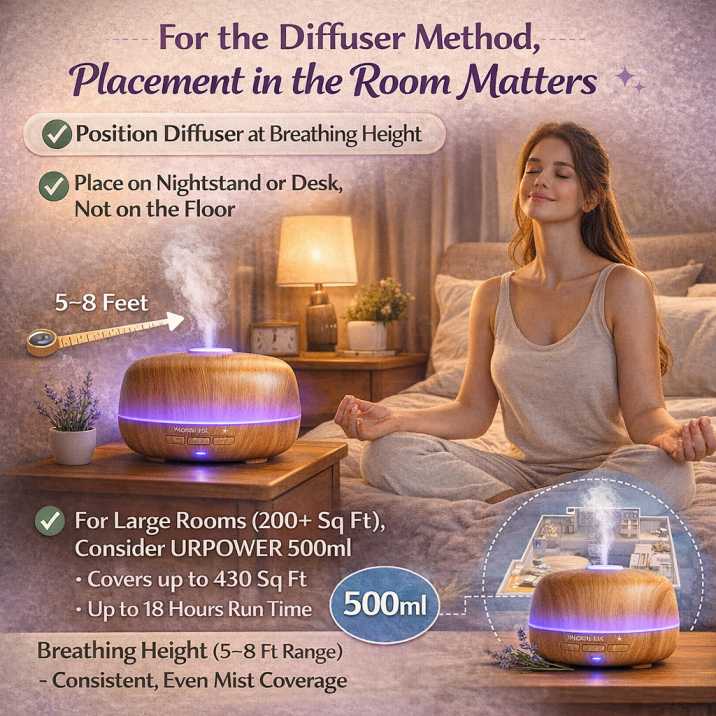
For the diffuser method, placement in the room matters. Position the diffuser at breathing height — on a nightstand or desk, not on the floor. Place it within 5–8 feet of where you'll be sitting, meditating, or sleeping. For larger rooms (over 200 sq ft), consider using a higher-capacity diffuser like the URPOWER 500ml which covers up to 430 sq ft and runs 18 hours on low mist for all-night anxiety relief without refilling.
For the 369 method morning anxiety ritual, diffuse frankincense + lavender together (3 drops each) during your morning writing session. Frankincense reduces cortisol and opens subconscious receptivity, while lavender activates the parasympathetic nervous system — the combination creates a potent morning anxiety protocol that conditions the nervous system through both limbic and cortisol pathways simultaneously.
Lavender Oil for Anxiety — Real Pros & Cons 2026
- Fastest complementary anxiety relief available OTC. Direct inhalation from the bottle produces measurable physiological response — reduced heart rate, lowered blood pressure, decreased respiratory rate — within 30–90 seconds.
- Strongest clinical evidence of any essential oil. 10 out of 11 controlled inhalation studies reported significantly decreased anxiety. Oral Silexan showed comparable efficacy to lorazepam and paroxetine in separate RCTs.
- No dependence, tolerance, or withdrawal potential. Unlike benzodiazepines, which the Silexan studies compared to, lavender produces anxiolytic effects without any known abuse potential.
- Works through multiple pathways simultaneously. Olfactory-limbic activation (inhalation), transdermal absorption into bloodstream (topical), and physiological breathing conditioning (when used with intentional breathing) — three separate mechanisms in one practice.
- Builds conditioned response over 2–3 weeks. Daily consistent use creates an olfactory anchor — your nervous system learns that this scent signals safety, producing increasingly fast and powerful responses over time.
- Safe for most populations at correct dilution. BPA-free, non-toxic at therapeutic doses. Suitable for most adults, elderly, children over 2, and pregnant women with appropriate guidance.
- Accessible and affordable. A quality 10ml bottle of Lavandula angustifolia runs $10–$18, providing approximately 200 topical applications or 30–40 diffuser sessions.
- Not a treatment for anxiety disorders. The NCCIH and the PMC research both note clearly: lavender oil is a supportive complementary tool, not a replacement for clinical treatment of diagnosed anxiety disorders. Severe anxiety requires professional care.
- Synthetic fragrance oils don't work. Many budget "lavender oils" are synthetic fragrance compounds or lavandin hybrids without the therapeutic linalool:linalyl acetate ratio. Only Lavandula angustifolia essential oil has the documented anxiolytic mechanism.
- Effects are short-duration without consistent practice. A single session produces 15–60 minutes of relief. Long-term benefit requires daily consistent use for at least 2–6 weeks to build the conditioned response and accumulate the parasympathetic training effect.
- Skin sensitization with improper use. Undiluted direct topical application, or diluted application too frequently over large skin areas, can cause sensitization — an immune response that reduces effectiveness and causes skin reactions over time.
- Medication interactions are real. Lavender may potentiate CNS depressants and interact with blood pressure medications. This is not a theoretical concern — the same calcium channel and serotonin receptor activity that makes it anxiolytic also makes it capable of drug interactions.
- Quality varies enormously by brand. Without GC/MS testing verification, many commercial lavender oils contain adulterated or diluted compounds. Always look for third-party tested, GC/MS verified, 100% Lavandula angustifolia oils.
What Lavender Oil Users Say About Anxiety Relief
"I apply diluted lavender to my wrists every morning before my commute. The anxiety I used to feel before big presentations — gone, or at least manageable. I bring my wrists to my nose and breathe slowly before walking into the meeting. It works faster than anything else I've tried and I've tried a lot."
"I run my VicTsing diffuser with 6 drops of lavender every night. I was waking up at 3am with anxiety racing thoughts — hasn't happened in 6 weeks since I started. The change was gradual but unmistakable. The anxiety doesn't stop, but my relationship with it is completely different."
"Temple application is the fastest for me. 1–2 minutes and I can feel my shoulders drop. I add it to the soles of my feet before bed — that combination of topical + diffuser running has honestly changed my sleep more than anything else I've done including medication."
"I keep a small roll-on with lavender and jojoba in my bag. When anxiety hits unexpectedly — at the grocery store, in traffic, before a phone call — I apply it behind my ears and take 5 breaths. It doesn't eliminate the anxiety but it takes it from a 7/10 to a 3/10 within a minute. That's enough to function."
"I was skeptical so I tried the Silexan capsules (Calm Aid) after reading the RCT data. Within two weeks I noticed a consistent baseline reduction in my anxiety levels — not sedation, just a quieter nervous system. I still use topical lavender but the capsules are a different level of consistent effect."
"It helps with mild everyday anxiety — absolutely. But I have GAD and genuinely thought lavender oil would replace my medication after reading some of the more enthusiastic reviews. It doesn't. It's a wonderful tool alongside treatment, not instead of it. Be realistic about what it can and cannot do."
Where to Put Lavender Oil for Anxiety — Real Questions Answered
The Final Word on Lavender Oil for Anxiety
Lavender oil is the most evidence-backed complementary tool available for anxiety management without a prescription. The mechanisms are pharmacologically real, the clinical evidence is stronger than for any other essential oil, and the application methods are accessible to anyone at $10–$18 per bottle.
For immediate anxiety relief: Direct inhalation from the bottle or a cotton ball — 30–90 seconds to noticeable effect. For all-day management: Wrist and temple application with diluted lavender in jojoba or fractionated coconut oil. For long-term nervous system conditioning and sleep: Overnight diffusion with a quality ultrasonic diffuser running on low mist.
Use only Lavandula angustifolia (true lavender) — GC/MS tested and verified. Dilute to 2% for skin application. Build a consistent daily practice for 2–4 weeks before evaluating effectiveness. And if your anxiety is severe or clinical: lavender oil is a supplement to professional care, never a replacement for it.
Everything You Need — Under $45 Total
Pure lavender oil + VicTsing diffuser + jojoba carrier oil. Ships free with Prime. Start tonight.