Alpha Brain
Waves Music
How sound guides your brain into its most creative, calm, and receptive state — and what the 2025–2026 neuroscience actually says about it.
01What Alpha Brain Wave Music Actually Is
Alpha brain wave music is not simply calming or pleasant background sound. That distinction matters, because a lot of what gets sold under this label is exactly that — relaxing audio with no specific neurological targeting. True alpha brain wave music is audio content deliberately engineered to encourage the brain to produce more alpha waves (8–12 Hz). It works through a mechanism called brainwave entrainment: the brain's tendency to synchronise its own electrical oscillations with rhythmic external stimuli.
The underlying neuroscience is well-established. The brain is not a passive receiver of sound — it actively synchronises with rhythmic patterns in its environment. This is why your foot taps to a beat automatically, why your heart rate slows to the tempo of slow music, and why a room full of pendulum clocks will eventually all swing in the same rhythm. When the rhythmic stimulus is precisely calibrated to a specific brainwave frequency, the brain's dominant electrical activity shifts toward that frequency. This is entrainment, and it is the mechanism behind every legitimate form of alpha brain wave music.
Three distinct audio formats can produce genuine alpha entrainment: binaural beats (a perceived phantom frequency created in the brain by delivering two slightly different tones to each ear), isochronic tones (a single tone pulsing on and off at the target alpha frequency), and purpose-composed instrumental music at 60–80 BPM with specific tonal properties. Each works differently, suits different contexts, and has a different evidence profile — all covered in full below.
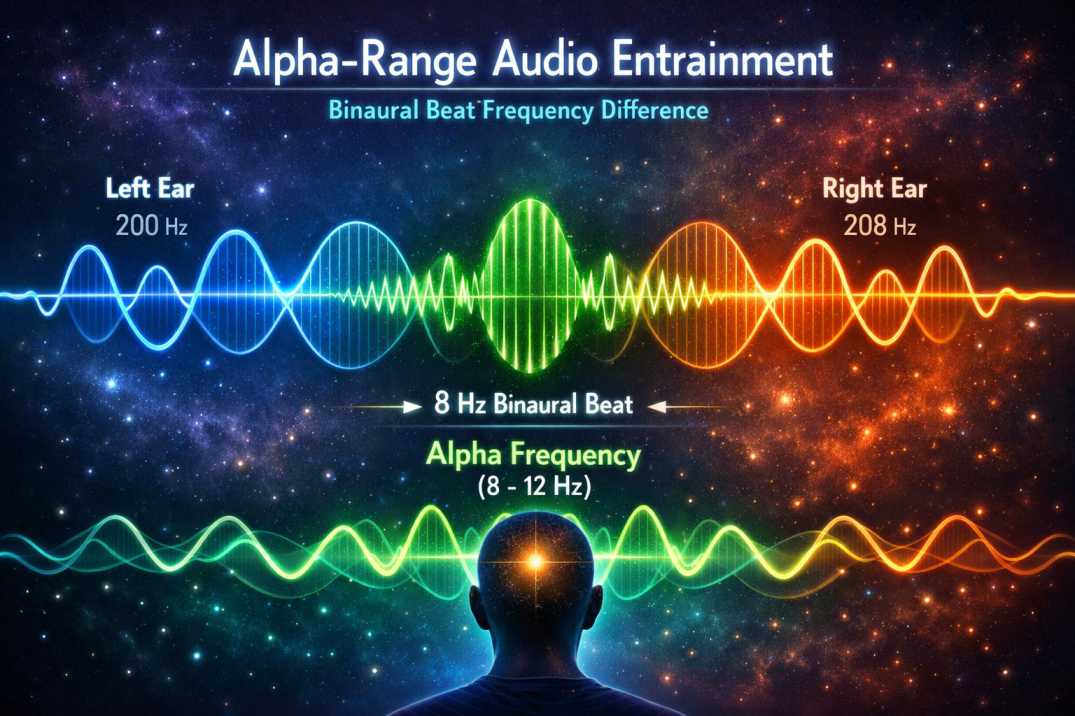
Most "alpha wave music" on YouTube and streaming platforms is simply slow, ambient music — pleasant, calming, but not actually engineered to entrain brainwaves. For genuine neurological effect, you need content that specifically delivers a binaural beat differential, isochronic pulse, or documented frequency composition. Generic relaxing music may help you feel calm, but it operates through emotional response rather than direct brainwave entrainment.
02The Science: How Sound Changes Your Brain
The mechanism connecting audio stimuli to brainwave patterns was first systematically studied in the 1830s when German physicist Heinrich Wilhelm Dove discovered binaural beats. The neuroscientific understanding of the process has deepened considerably since — and the 2025 University of Texas research by Anastasiia Melnichuk provided something the field had long needed: direct EEG confirmation that the brain actually synchronises with the target frequency.
The frequency-following response (FFR) is the core mechanism. When your auditory system detects a rhythmic stimulus — whether a binaural beat differential, an isochronic pulse, or a regular musical rhythm — neurons in the brain begin synchronising their firing pattern to match. The superior olivary complex in the brain stem is the first processing point, integrating signals from both ears and initiating the neural entrainment cascade. Over 5–10 minutes of consistent exposure, this synchronisation becomes measurable on EEG as a shift in the dominant brainwave frequency toward the target.
For alpha-range music specifically, the well-documented effects include: reduced cortisol production (the physiological stress hormone), increased sense of calm and cognitive openness, reduced neural suppression of the frontal cortex (unlocking creative associations), and a smooth transition from the high-beta arousal of busy daily life toward a state where the brain can actually rest, recover, and integrate information. PMC research published in a peer-reviewed literature review confirms alpha waves are therapeutically associated with mental relaxation, visualisation, creative processes, memory optimisation, and pain perception modulation.
The impact of music on the brain goes beyond entrainment alone. A peer-reviewed PMC study on the impact of music on bioelectrical oscillations found that not only listening to but even imagining music elicits posterior alpha activity — and that imagery produces significantly greater alpha power in posterior areas than direct perception. This is a remarkable finding: the relaxed, internally focused state of musical imagination is itself an alpha-producing activity, independent of any engineered frequency.
03Choosing the Right Alpha Frequency (8–12 Hz)
The alpha band spans 8–12 Hz, but it is not uniform across that range. Neuroscientists divide it into two meaningful sub-bands, each with distinct cognitive and physiological associations. Choosing the right one for your purpose matters more than most alpha music guides acknowledge.
If you are stressed or anxious and want to wind down → start with 8–9 Hz. If you want to meditate deeply or ease into sleep → use 8–10 Hz. If you want to enter a creative working state, brainstorm, or approach a problem with fresh perspective → choose 10–12 Hz. If you are unsure → 10 Hz is the universal baseline with the most research support and the most consistent individual response.
04Binaural Beats — How They Work
Binaural beats are the most widely known and widely available form of alpha brain wave music, and they are also the most frequently misunderstood. The physics are straightforward: you deliver two slightly different audio tones — one to each ear through stereo headphones. Your brain perceives the difference between these two frequencies as a third, phantom tone.
For example: a 440 Hz tone enters your left ear, and a 450 Hz tone enters your right ear. No 10 Hz sound exists in the room — but your brain constructs one internally from the 10 Hz difference between the two signals. That internally generated 10 Hz frequency is the binaural beat, and your brain's electrical activity begins synchronising to it through the frequency-following response.
The Three Rules for Binaural Beats to Work
First: both carrier tones must be below 1,500 Hz, and the difference between them must not exceed 40 Hz. Tones outside these parameters do not create a reliable binaural beat. Second: you must use stereo headphones — not speakers. Each ear must receive a distinct frequency. With speakers, both ears hear both tones simultaneously, and the binaural effect collapses. Third: the brain needs 5–6 minutes of consistent exposure before entrainment becomes measurable. Binaural beats are not immediate — they are a process.
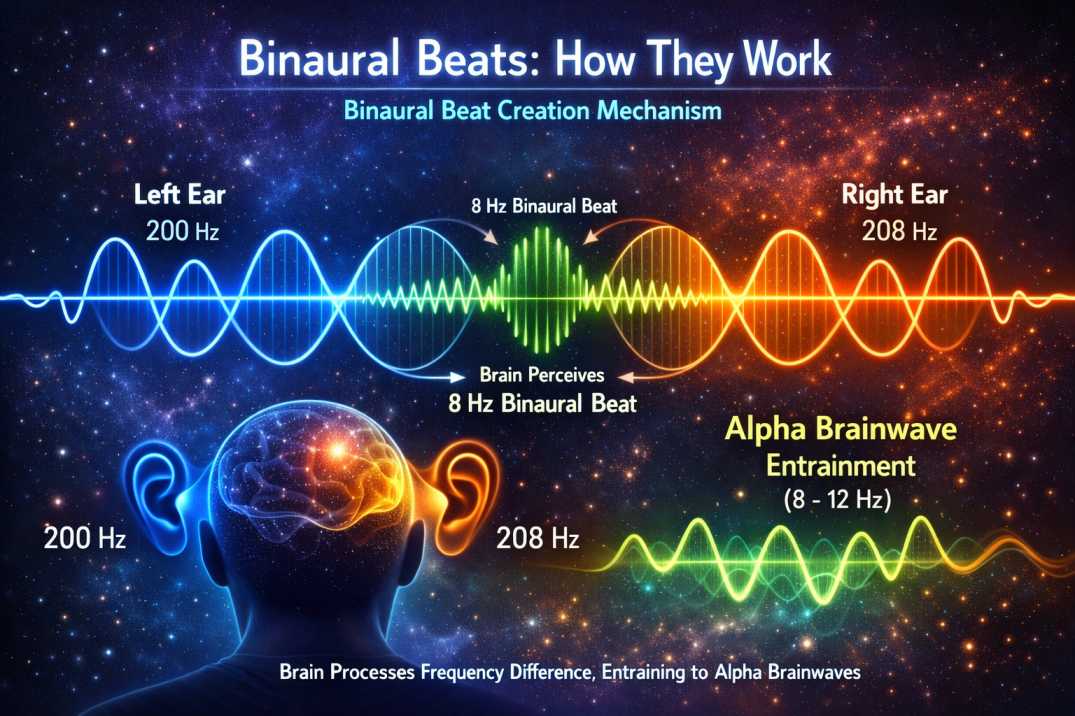
The key limitation of binaural beats compared to isochronic tones: the waveform produced inside the brain has a very shallow modulation depth — approximately 3 dB (a 2-to-1 ratio), according to researcher David Siever's 2009 analysis. This produces a relatively weak cortical evoked response, which is why some individuals report minimal effect from binaural beats while others find them highly effective. Individual variability in response is the rule, not the exception.
05Isochronic Tones — The Stronger Signal
Isochronic tones are the less famous but neurologically more powerful sibling of binaural beats. Where binaural beats create their effect inside the brain through the difference between two external tones, isochronic tones are single tones that pulse on and off at a precise rhythm matching the target brainwave frequency. They exist fully-formed in the audio before they reach your ear.
The 10 Hz isochronic tone pulses on and off exactly 10 times per second. Your brain detects this rhythmic pulsing and begins synchronising its neural activity to match the 10 Hz rhythm. Because the signal is clear, external, and unambiguous — not a phantom created internally — it produces a significantly stronger brain response.
Research confirms the superiority in signal strength: isochronic tones produce approximately 50 dB modulation depth (a 100,000-to-1 ratio), compared to binaural beats' 3 dB (2-to-1 ratio). In practical terms, this means a much stronger and more consistent cortical evoked response. A peer-reviewed literature review confirmed that isochronic tones have a 15% higher effect in modulating brainwave frequency activity compared to binaural beats in the prefrontal cortex. Additionally, isochronic tones work without headphones — though headphones still enhance the effect.
The sound of isochronic tones — a rapidly pulsing tone switching on and off — is less aesthetically pleasant than binaural beats, which blend into music more smoothly. Many people find pure isochronic tones uncomfortable for extended listening. The practical solution: isochronic tones are often embedded in ambient music tracks, where the pulse is present but masked by the surrounding music. These hybrid tracks offer the stronger entrainment effect of isochronic tones with the more pleasant listening experience of music. A 2020 study with 60 participants found 8 Hz isochronic tones actually decreased alpha activity — a reminder that protocol, carrier frequency, and listening conditions all matter significantly.
06Binaural Beats vs Isochronic Tones vs Regular Music
Three distinct audio formats can encourage alpha states. Here is an honest comparison across the variables that matter most for practical use:
| Feature | Binaural Beats | Isochronic Tones | Regular Calm Music |
|---|---|---|---|
| How It Works | Brain creates phantom frequency from two tones (one per ear) | Single tone pulsing on/off at target frequency | Emotional/tempo response; no direct entrainment |
| Headphones Required | Yes — mandatory | No — optional | No — speakers fine |
| Signal Strength | Weak (3 dB modulation depth) | Strong (50 dB modulation depth) | Indirect — not frequency-specific |
| Entrainment Evidence | Moderate — EEG confirmed 2025 | Strong — 15% better prefrontal effect | Indirect — via relaxation response |
| Listening Experience | Smooth, blends with music well | Pulsing — less pleasant without music overlay | Most pleasant — no artificial tone |
| Best Use | Meditation, relaxation, sleep entry | Focus, learning, stronger entrainment needed | Ambient background, gentle relaxation |
| Individual Variability | High — some feel no effect | Moderate — more consistent response | Very high — depends on personal music taste |
07Best Use Cases — What Alpha Music Is Actually Good For
Alpha brain wave music is not a universal solution for all mental states. It performs some functions extremely well and others not at all. Here is an honest account of where the evidence actually supports its use:
Alpha's primary role is inhibiting the high-beta stress response. Alpha music at 8–10 Hz consistently reduces physiological stress markers including cortisol and heart rate in controlled studies. This is alpha music's most evidence-supported use for both USA and European clinical contexts.
Strong EvidenceUpper alpha (10–12 Hz) reduces prefrontal cortex executive filtering — the mental voice that critiques ideas before they fully form. Alpha music during creative sessions (not during focused technical work) can support more divergent, freely associative thinking linked to genuine creative output.
Good EvidenceFor people who struggle to enter meditative states, alpha music provides an external scaffold — guiding the brain toward the alpha-theta frequency range that experienced meditators reach naturally. 10 Hz music during meditation produces measurably deeper states than silence alone for many beginning practitioners.
Strong EvidenceAlpha music at 8–9 Hz during the 20–30 minutes before sleep helps the brain begin its natural downshift from beta dominance toward the alpha-theta transition needed for smooth sleep onset. This is distinct from sleep music itself — alpha music helps you get to the point of falling asleep, not staying asleep.
Good EvidenceListening to alpha music during the rest periods between focused study sessions supports the theta processing that converts short-term learning into memory. This is one of alpha music's most underutilised and research-supported applications — not during studying, but during the breaks between study blocks.
Neuroscience-BackedThe PMC literature review confirms alpha waves modulate pain perception threshold. Audio-Visual Entrainment at alpha frequencies has shown reduced patient anxiety and heart rate during dental procedures. Alpha music may support pain management as a non-pharmacological adjunct, particularly for chronic stress-related pain amplification.
Emerging Evidence08When NOT to Use Alpha Wave Music
This is the section most alpha music guides skip entirely, because it conflicts with their promotional intent. But the research is unambiguous on at least one critical point: alpha music can impair performance when used during active cognitive tasks.
A 2023 study of 1,000 participants found that binaural beats during intelligence testing produced worse results than silence. This aligns with the fundamental neurological mechanism: alpha reduces prefrontal executive activity. That is exactly what you want during relaxation, creativity, and meditation. It is precisely what you do not want during sequential analysis, reading comprehension, mathematical calculation, or problem-solving under pressure.
Active reading and study — reduces comprehension for many people. Exams or tests — directly impairs performance in controlled research. Analytical work — writing code, financial modelling, legal drafting, or anything requiring sustained logical focus. Driving or operating machinery — alpha reduces alertness, which is the opposite of what safety-critical activities require. As a treatment for clinical conditions without professional guidance — alpha music supports wellbeing but does not replace clinical care for anxiety disorders, depression, or PTSD.
The right framework: use alpha music before tasks (to transition into the right state) and between tasks (to recover and process). Do not use it during demanding cognitive work. Alpha is a preparation and recovery tool, not a focus enhancer. If you want music that genuinely supports focus during active work, beta-range entrainment or purpose-engineered focus music (not alpha) is the appropriate choice.
09How to Listen for Best Results — 5 Steps
Getting reliable results from alpha brain wave music requires correct technique. Most people underuse it by treating it like ambient background music while doing other things — which produces minimal effect. Here is how to use it properly:
10Honest Limitations — What the Research Doesn't Confirm
Alpha brain wave music carries genuine promise and genuine limitations. Any guide that presents only the benefits is misleading you. Here is what the evidence does not — or not yet — support:
| Common Claim | Evidence Status | What the Research Actually Shows |
|---|---|---|
| Alpha music improves memory | Mixed | 10 Hz improves working memory in some populations (especially older adults with reduced alpha); results vary significantly by individual and protocol |
| Alpha music cures anxiety | Overstatement | It measurably reduces acute anxiety in sessions; it does not cure or permanently resolve clinical anxiety disorders |
| IQ increases with alpha training | Limited | One study showed IQ improvements in children with disabilities using 10+18 Hz training; this does not generalise to healthy adults |
| Longer sessions always produce stronger effects | Not supported | Diminishing returns apply; excessive alpha can produce drowsiness or inattention, and prolonged sessions may reduce effectiveness |
| One-time sessions produce lasting changes | Limited | Single sessions produce acute state changes; lasting neurological benefits require consistent, regular practice over weeks |
| Alpha music works the same for everyone | False | Individual variability in entrainment response is one of the most consistently reported findings across all brainwave entrainment research |
Alpha brain wave music is a legitimate, evidence-supported tool for relaxation, stress reduction, and creating the mental conditions for creativity and meditation. It is not a cognitive performance enhancer for active work, not a clinical treatment, and not uniformly effective for everyone. Used correctly — the right frequency, the right environment, the right duration, and for the right purpose — it delivers on its core promise. Used incorrectly, it ranges from ineffective to mildly counterproductive. The difference is almost entirely in how it's applied.
11Frequently Asked Questions
Sound as a Tool,
Not a Shortcut
Alpha brain wave music works. It also fails — consistently and predictably — when used incorrectly. The science is clear on both sides. Used as a preparation and recovery tool, at the right frequency, in the right environment, through the right audio format, it genuinely guides your brain into its most creative, calm, and receptive state. Used as background noise during demanding work, or as a substitute for sleep, exercise, or clinical care, it does nothing meaningful and sometimes makes things worse. The technology is sophisticated. The approach should match it.