Alpha Brain
Waves
The complete science guide to 8–12 Hz neural oscillations — what they are, what they genuinely do, what the newest 2026 research reveals, and how to cultivate them.
01What Alpha Brain Waves Actually Are
Alpha brain waves are rhythmic electrical oscillations produced when large populations of neurons in the brain fire together in a synchronized pattern at a rate of 8 to 12 times per second. They are measured in Hertz — cycles per second — and their 8–12 Hz range sits squarely between the faster beta waves of active cognition and the slower theta waves of drowsiness and sleep.
The experience of alpha is familiar to everyone, even if the word isn't. It's the mental quality of a Sunday morning before the day has made any demands. It's the state of sitting in a garden with no particular agenda. It's the comfortable, unhurried awareness of someone doing a task they know well — experienced enough that the work flows without strain. Alpha is the brain's natural resting rhythm for a conscious, functional adult.
The defining characteristic of alpha is what neuroscientists call relaxed alertness: the brain is not actively processing new information or solving complex problems, but it is fully awake, fully conscious, and fully available to respond when needed. Alpha doesn't signal mental weakness or disengagement — it signals a brain that is in recovery and preparation mode, integrating recent experience and readying itself for what comes next.
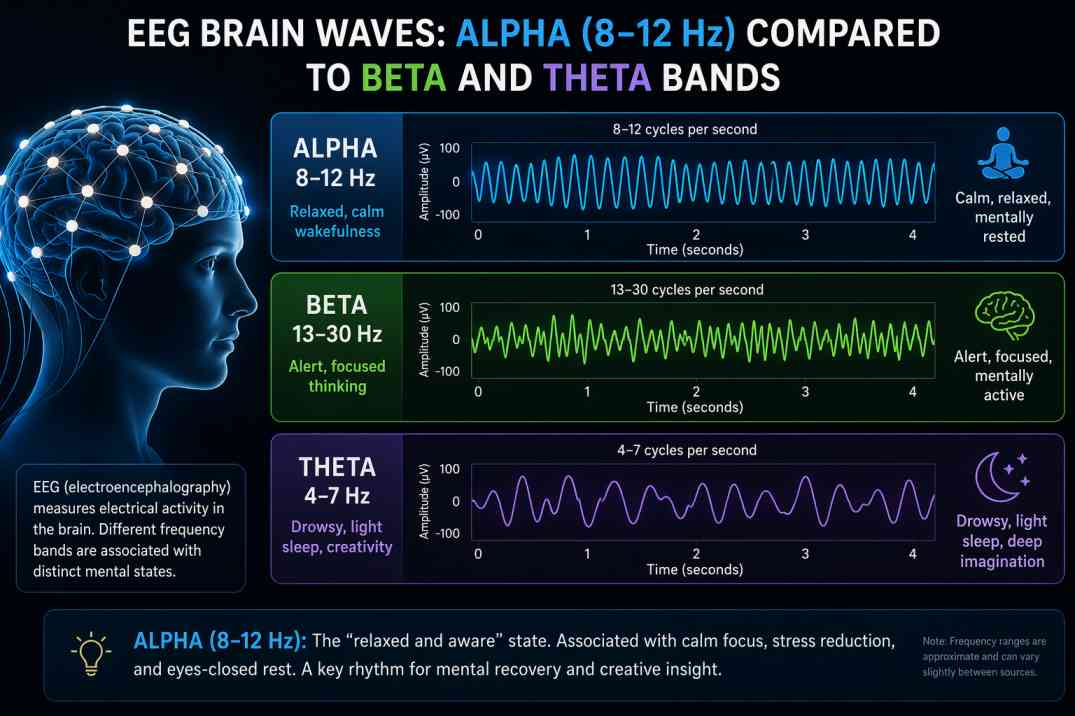
Alpha activity is most prominent over the occipital cortex (the back of the head, governing visual processing) and over the parietal regions (upper back of the head, governing sensory integration). It is strongly suppressed when the eyes open — because visual input immediately activates the processing systems that alpha's idle mode had quieted. Alpha also appears over the frontal cortex in different contexts, particularly during internally directed attention and meditation.
02Discovery: The First Brainwave Ever Found
Alpha waves hold a unique distinction in neuroscience: they were the first human brainwave pattern ever identified. This happened in the 1920s through the work of German psychiatrist Hans Berger — a discovery that was initially met with scepticism, then transformed the entire field of brain science.
03How Alpha Actually Works in the Brain
For decades, alpha was considered the brain's passive "idling" state — a default rhythm with no active function. Modern neuroscience has overturned this view entirely. Alpha is now understood to be an active, purposeful inhibitory mechanism.
The function, confirmed through extensive research published in ScienceDirect and multiple peer-reviewed journals, is: alpha oscillations perform active and adequate inhibition of irrelevant sensory pathways. When your brain produces alpha waves over a particular region, it is actively suppressing the processing of information in that region — not because nothing is happening there, but because something more important is happening elsewhere and needs resources.
Think of it as selective silence. When you close your eyes and focus on a sound, alpha waves increase over the visual cortex (shutting down visual processing) and decrease over the auditory cortex (opening up acoustic processing). Alpha doesn't mean the brain is asleep. It means the brain is strategically allocating attention — deciding what to process and what to ignore.
The White Matter Connection
Research shows alpha rhythms are derived from the white matter of the brain — the neural pathways that connect all brain regions to each other. This is why healthy alpha production is linked to mental coordination and mental resourcefulness: it reflects the efficiency of the brain's connectivity infrastructure. The faster your alpha peak frequency, the more efficiently signals travel between brain regions.
This white matter connection also explains alpha's relationship to aging — a relationship that 2025–2026 research has now mapped with precision. As myelin (the insulating sheath around nerve fibres) degrades with age, neural conduction slows, and alpha frequency drops. This is not merely a correlation — the Xi–αNET model published in National Science Review proved the causal link, demonstrating that myelin thickness directly sets alpha frequency across the lifespan.
04All 7 Documented Benefits of Alpha Brain Waves
What follows is an honest, evidence-grounded assessment of alpha's documented benefits. No exaggeration, no padding. Each benefit has research support — some strong, some moderate — and that distinction is noted for every one.
Alpha waves calm the mind by reducing the dominance of high-beta stress patterns. Research shows alpha increases are associated with cortisol reduction and activation of the parasympathetic nervous system — the "rest and digest" state that counteracts stress physiology.
Strong EvidenceA 2015 randomised trial found that specifically enhancing alpha waves triggered a measurable surge in creativity. Alpha reduces the prefrontal cortex's executive filtering, allowing freer associative thinking — the mental mode underlying creative insight and problem-solving.
Good Research SupportNIH-published clinical trial data confirms higher alpha amplitudes are associated with improved working memory, attention, vigilance, information processing speed, and inhibitory processes. Alpha binaural beat stimulation at 10.2 Hz improved Stroop test performance in research participants.
Peer-Reviewed — NIHResearch consistently shows reduced frontal alpha activity in people with depression. Alpha neurofeedback training has been studied as a clinical intervention for both depression and depression-related insomnia, with promising results in reducing both symptom severity and sleep disruption in remitted patients.
Clinical ResearchAlpha appears naturally in the transition from wakefulness to sleep. A healthy alpha-theta transition at sleep onset is associated with smooth, efficient sleep entry. When chronic high-beta suppresses alpha, people experience difficulty falling asleep — a common symptom of stress-driven insomnia.
Strong Sleep ResearchA January 2026 study by Karolinska Institutet (Nature Communications) found that parietal alpha frequency directly shapes how the brain integrates bodily signals — determining your sense of physical self and body ownership. Faster alpha frequencies produce more accurate bodily self-perception.
New 2026 ResearchAlpha states allow the brain to integrate and process recent experiences without the metabolic cost of active processing. Regular access to alpha — through breaks, meditation, or nature time — supports sustained cognitive performance across longer work periods by enabling genuine neural recovery.
Good Evidence05Alpha Waves and Creativity — The Mechanism
The relationship between alpha and creativity is one of the most replicated findings in cognitive neuroscience, and yet it's frequently described in ways that miss the actual mechanism. Alpha doesn't produce creativity directly. It produces the mental conditions in which creativity becomes possible. That distinction matters for applying it practically.
In high-beta cognitive states — active analysis, focused task execution, anxious problem-solving — the prefrontal cortex is powerfully dominant. This is excellent for sequential logic but counterproductive for creative insight, because the prefrontal cortex aggressively filters and evaluates ideas before they can fully form. It suppresses associations that seem unlikely or unrelated. This is precisely its job during analytical work.
Alpha reduces this suppression. When alpha dominates over the frontal regions, the executive filter loosens. Remote associations — the kind that produce the surprising, original connections that define creative thought — become more available. EEG studies consistently show increased frontal alpha in creative individuals when they are in the moments just before or during creative insight. This is why artists, musicians, writers, and athletes frequently describe their most productive states as a kind of relaxed, effortless flow rather than intense mental effort.
The Brown University Research
Neuroscientists at Brown University have studied the brain's mechanism of "optimal inattention" — using alpha oscillations to strategically ignore irrelevant information. Their research, published in the Journal of Neuroscience, showed that alpha and beta synchronisation between the right inferior frontal cortex and primary sensory neocortex is the mechanism behind selective attention. The ability to not attend to distractors — to tune out mental noise — is as important to creative and focused performance as the ability to focus. Alpha is the frequency through which this selective silencing operates.
If you consistently struggle with creative blocks, the most neurologically grounded explanation is chronic high-beta dominance — a brain that cannot produce enough alpha to quiet the critical executive voice long enough for novel associations to form. The intervention is not more effort but deliberate alpha cultivation: meditation, slow breathing, time away from screens, and the structured creative rest periods described in Section 9 of this guide.
06Alpha, Anxiety and Depression — The Clinical Picture
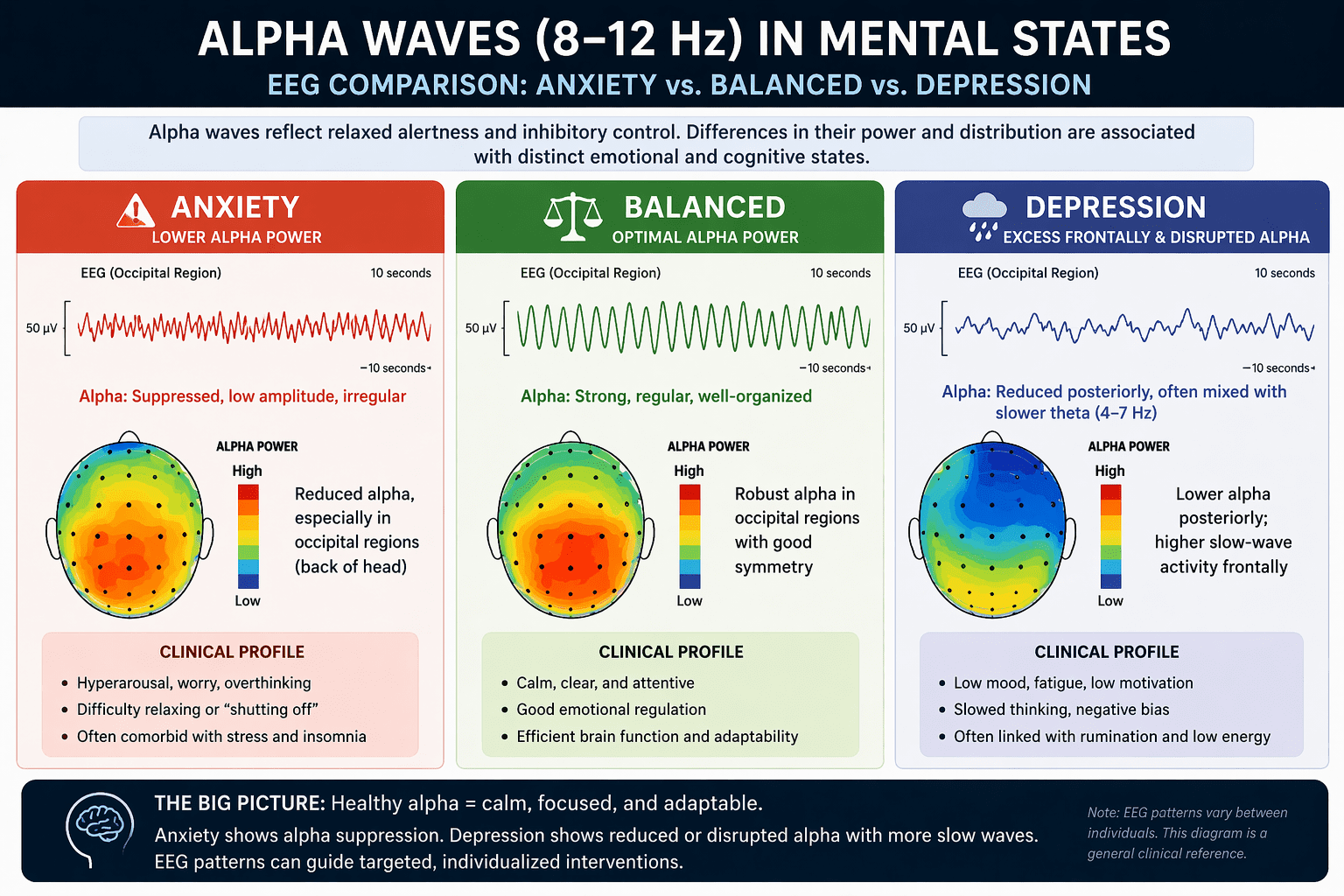
The relationship between alpha waves and mental health is one of the most clinically researched areas in EEG neuroscience. Two conditions receive particular attention: anxiety disorders and depression. The alpha patterns differ between them, which matters for understanding both the problem and the intervention.
Alpha and Anxiety
Anxiety is, neurologically, a state of high-beta dominance. When the brain is chronically anxious, high-frequency beta activity (particularly in the 20–30 Hz range) dominates, and alpha is correspondingly suppressed. The body remains in a persistent fight-or-flight readiness state because the brain's natural relaxation rhythm cannot assert itself against the dominant stress signal.
A 2014 neurofeedback study found that participants with generalised anxiety disorder (GAD) who underwent alpha neurofeedback training successfully increased their alpha amplitude — and this increase directly correlated with reduced anxiety and increased sense of calm. More recent research confirms this: alpha neurofeedback is among the better-evidenced non-pharmacological interventions for GAD available to practitioners in both the USA and Europe.
Alpha and Depression
Depression presents a different alpha pattern. Research consistently shows reduced alpha activity in the frontal and occipital regions in people with depression — not an excess of beta, but a general suppression of the relaxed-alert state across key brain regions. People with depression often describe difficulty experiencing pleasure, calm, or mental clarity — subjective experiences that correspond precisely to reduced alpha availability in the brain's resting-state networks.
Alpha neurofeedback and transcranial alternating current stimulation (tACS) targeting alpha frequencies have been studied in clinical trials for major depressive disorder. A 2019 double-blind randomised pilot trial targeting alpha oscillations with tACS showed promising results. A 2025 study specifically examined alpha neurofeedback training to enhance sleep in patients with remitted depression and persistent insomnia, with positive outcomes — addressing both conditions through a single alpha-targeted intervention.
Low alpha / poor relaxation
Calm + focused
Reduced engagement
07The 2026 Breakthrough: Alpha Waves and Brain Aging
One of the most significant findings of recent years — finalised and published in National Science Review in 2025–2026 — concerns the relationship between alpha frequency and the physical structure of the aging brain. This research changes how we understand alpha entirely, from a state-marker to a biological indicator of neural health.
A multinational team analyzed EEG recordings from 1,965 people across nine countries and introduced the Xi–αNET model, which links two familiar EEG features — broadband background activity and alpha oscillations — to the brain's physical wiring and signal-conduction speed.
The key finding: alpha frequency is directly set by myelin thickness. Myelin is the fatty insulating sheath surrounding nerve fibres that determines how fast electrical signals travel between neurons. Thicker myelin = faster conduction = higher alpha frequency. Thinner myelin (as occurs with age or neurological disease) = slower conduction = lower alpha frequency. This is why children, with rapidly developing myelin, tend to show faster alpha frequencies; and why older adults, with naturally degrading myelin, show the characteristic "alpha slowing" that EEG clinicians have observed for decades.
The clinical implication is substantial. Because alpha slowing precedes the overt symptoms of Parkinson's disease and other neurodegenerative conditions, monitoring alpha peak frequency through routine EEG may allow earlier detection than any currently available method. The researchers demonstrated that their model could detect the characteristic alpha slowing signature of Parkinson's patients — a finding that may eventually translate into accessible clinical screening tools available across both the USA and European healthcare systems.
For adults who want to monitor or protect their cognitive health, alpha frequency is now understood to be a meaningful indicator — not just of current mental state, but of white-matter integrity and neural conduction efficiency. Regular meditation and physical exercise are the two best-documented methods for preserving and supporting healthy alpha frequency across the lifespan. Aerobic exercise specifically promotes myelin health through BDNF (brain-derived neurotrophic factor) production.
08The Karolinska 2026 Finding: Alpha and Body Ownership
A study published in Nature Communications in January 2026 by researchers from Karolinska Institutet in Sweden and Aix-Marseille Université in France added a genuinely unexpected dimension to alpha research: the discovery that parietal alpha frequency directly shapes your sense of bodily self — the continuous, moment-to-moment experience that your body belongs to you.
Using the well-established rubber hand illusion (where a fake hand can be made to feel like part of the participant's own body through synchronized touch), the researchers found that people with faster parietal alpha frequencies were better at detecting small timing differences between visual and tactile signals — the brain's fundamental mechanism for integrating sensory information into a coherent sense of physical self.
"We have identified a fundamental brain process that shapes our continuous experience of being embodied," said lead author Mariano D'Angelo. "The findings may provide new insights into psychiatric conditions such as schizophrenia, where the sense of self is disturbed." The researchers also noted implications for prosthetic limb design and virtual reality experiences — both fields where the integration of external and internal bodily signals is critical to effectiveness.
This finding connects to a parallel finding in Nature Communications (March 2026) that faster alpha rhythms boost visual accuracy by increasing the probability of catching visual stimuli at optimal processing phases — confirming that alpha frequency is not merely a relaxation marker but a fundamental parameter of perceptual precision across multiple sensory domains.
The Karolinska finding has practical relevance for anyone experiencing dissociation, depersonalisation, or the blunted bodily awareness that often accompanies chronic stress, trauma, or depression. These experiences now have a neurological correlate in parietal alpha dynamics. Practices that increase alpha — particularly those involving body awareness (yoga, tai chi, body scan meditation, breathwork) — are no longer simply relaxation tools. They are, in part, tools for restoring the neural precision that underlies healthy bodily self-perception.
09How to Increase Alpha Waves — 7 Evidence-Based Methods
Alpha cannot be forced — a truth that applies to all the beneficial brainwave states. Every reliable method for increasing alpha works by removing the conditions that suppress it: principally, high-beta stress arousal, excessive visual stimulation, and the chronic mental noise of an overscheduled life. Here are the seven methods with the strongest evidence base:
10Alpha vs All Other Brainwaves — The Complete Comparison
Alpha occupies a specific and non-substitutable position in the brainwave spectrum. Understanding where it sits relative to the other four major bands helps clarify why it matters and what it cannot be replaced by:
| Brainwave | Frequency | Primary State | Role | Deficit Sign |
|---|---|---|---|---|
| Delta | 0.5–4 Hz | Deep sleep | Physical repair, memory transfer | Fatigue, immune suppression |
| Theta | 4–8 Hz | REM sleep, deep meditation | Memory encoding, emotional processing | Poor memory, emotional instability |
| Alpha ✦ | 8–12 Hz | Relaxed wakefulness | Recovery, creativity, sensory inhibition | Anxiety, depression, poor relaxation |
| Beta | 12–30 Hz | Alert, focused, active | Task execution, working memory gating | Inattention, brain fog |
| Gamma | 30–100 Hz | Peak cognition, insight | Cross-regional information binding | Reduced integration, age-related decline |
Alpha's unique position — between theta's subconscious depths and beta's active surface — makes it the brain's essential transition state. It is how the brain moves between sleep and waking. It is how the brain moves between focused work and creative reflection. It is how the brain moves between external demands and internal recovery. Every other cognitive state depends on alpha being accessible when the brain needs to shift gears.
This is why chronic high-beta states — the hallmark of modern stress culture — are so cognitively costly. A brain that cannot produce adequate alpha cannot transition smoothly between states. It stays locked in effortful engagement, burns metabolic resources unsustainably, and loses access to the creative, restorative, and emotionally integrative functions that only the alpha state makes available.
11Frequently Asked Questions
The Brain's Most Overlooked
Recovery State
Alpha brain waves are not a wellness cliché or a meditation accessory. They are the neurological mechanism through which your brain relaxes, integrates, creates, and prepares. The brain that cannot produce adequate alpha is a brain stuck in permanent demand — analytically capable, perhaps, but losing access to creativity, emotional equilibrium, and the restorative transitions that make sustained high performance possible. Understanding alpha is, ultimately, understanding what rest actually means at the level of neural architecture.