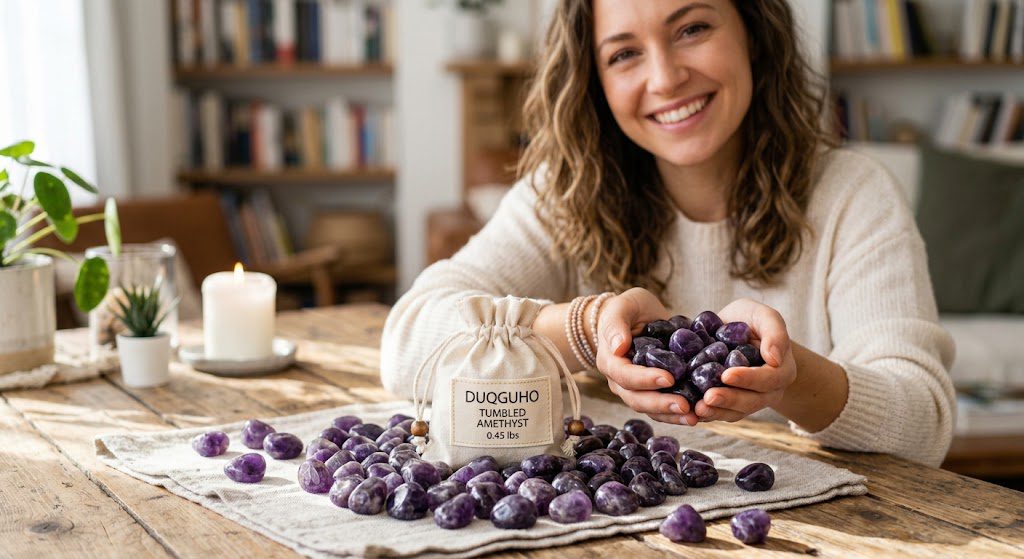
Side-by-side comparison
| Amethyst | Rose quartz | |
|---|---|---|
| Mineral | Quartz (SiO₂), the purple variety | Quartz (SiO₂), the pink variety |
| What causes the color | Trace iron plus natural irradiation | Mostly microscopic fibrous inclusions related to dumortierite |
| Appearance | Transparent to translucent, pale lilac to deep violet | Milky, hazy pink. Rarely fully transparent |
| Typical form | Prismatic crystals and clusters, often from geodes | Usually massive chunks. Well-formed crystals are rare |
| Hardness | 7 on the Mohs scale | 7 on the Mohs scale |
| Color stability | Can fade with strong light or heat | Stable in normal use, but avoid long, strong sunlight |
| Common products | Clusters, geodes, points, faceted jewelry | Tumbled stones, hearts, spheres, rollers, beads |
| Traditional associations | Calm, clarity, sobriety (Greek tradition) | Love and compassion (modern crystal tradition) |
Why they look so different
Amethyst gets its violet from iron impurities in the quartz lattice that have been changed by natural irradiation. Because the crystal stays clear, light travels through it, which gives amethyst its glassy depth. Color is often uneven, with the strongest purple near the crystal tips.
Rose quartz works differently. Its pink usually comes from tiny fibers related to the mineral dumortierite, which scatter light and make the stone look soft and hazy. That is why truly transparent rose quartz is much rarer than the milky kind.
The science is still debated in places. Researchers have also described a rarer "pink quartz" that gets its color from irradiation-related color centers, and it behaves differently from common rose quartz.
What the research says
There is no good evidence that either stone affects health or emotions beyond suggestion. In the best-known test, psychologist Christopher French and colleagues at Goldsmiths, University of London, gave volunteers either real or fake crystals to hold during meditation. People reported the same sensations either way, and those more open to paranormal ideas reported stronger ones.
Many people still enjoy crystals as objects, for ritual or as a calming habit. That is a valid reason to buy one. It is not a reason to expect a medical result. Treat any seller claim about healing, curing, or "energy" as marketing.
Real vs fake: what to watch for
Amethyst red flags
- Perfectly even, bright purple everywhere. Natural amethyst usually shows color zoning.
- "Electroplated" or "aura" coatings. Some listings openly describe clusters as electroplated. That is a coating, not natural color.
- Bubbles or swirl marks inside. These suggest glass.
- Heat-treated stones sold as other gems. Heating amethyst can produce yellow citrine, so check what is actually being sold.
- Faded or pale pieces. Amethyst can lose tone if overexposed to light.
Rose quartz red flags
- Neon or candy-bright pink. Natural rose quartz is soft and often pale.
- Color pooled in cracks. This points to dye.
- Dye rubbing off on a damp cloth. Natural color does not rub off.
- Perfectly clear, bubble-free "gem" pink. Truly transparent rose quartz is uncommon, so be cautious.
- Vague origin and no description of treatment. Good sellers say where it is from and whether it is treated.
No home test is perfect. If a stone matters to you, buy from a seller who describes origin and any treatments, and check the return policy.
Care and durability
Both are hard enough for everyday handling (7 on the Mohs scale), but hardness is not the same as toughness, and a hard knock can still chip or crack them. Keep both out of long, strong sunlight, since amethyst can fade and rose quartz is best protected too. Wipe with a soft cloth, and avoid harsh chemicals.
Buying checklist
Amethyst
- Form: cluster or geode for display, tumbled stones for carrying.
- Origin: sellers often name Uruguay or Brazil. A named origin is better than none.
- Color: natural zoning is a good sign. Perfect uniformity is a warning.
- Base: a flat-cut base makes clusters stable on a shelf.
Rose quartz
- Form: tumbled stones for carrying, raw pieces for display, hearts for gifts.
- Color: soft and slightly hazy is normal.
- Treatment: ask if the stone is dyed. If the listing is silent, be careful.
- Size: check actual stone size, since bags vary a lot.
Top picks
These are popular options in each category on Amazon. Check the current listing for size, what is included, and today's price.
Natural Amethyst Cluster, 0.75–1 lb (Uruguay)
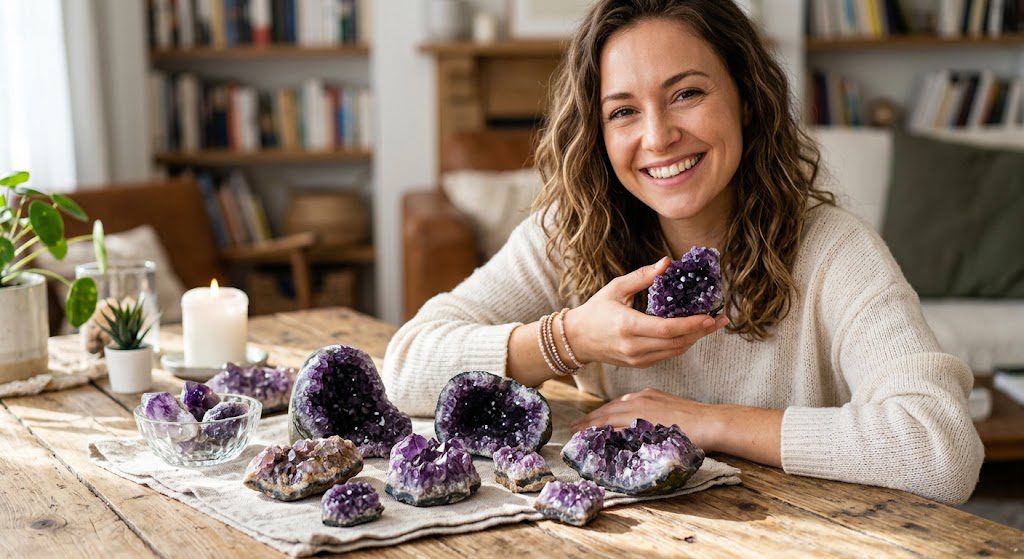
A raw amethyst cluster with polished edges and a flat base so it sits steadily on a shelf. It has ranked well among healing-crystal listings.
Trade-off: each piece is different, so color and shape vary from the photos. Check the return policy.
Check on AmazonDUQGUHO Amethyst Tumbled Stones Set
A bag of polished tumbled amethyst that has carried Amazon's Choice. A low-commitment way to try amethyst or to carry a stone in your pocket.
Trade-off: tumbled pieces lose the dramatic crystal points of a cluster, and color varies stone to stone.
Check on AmazonHilitchi Tumbled Brazilian Rose Quartz, 1 lb Bag
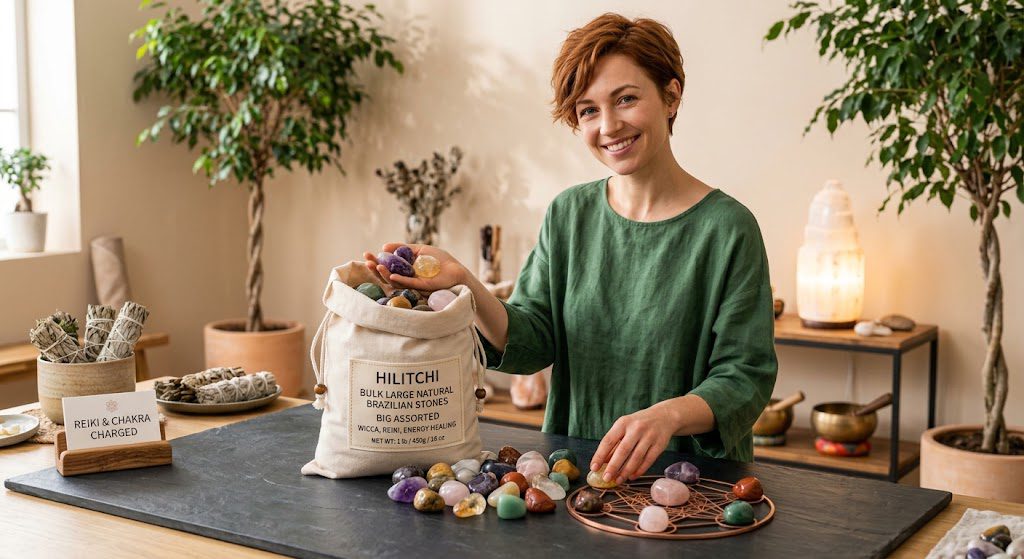
Natural tumbled rose quartz from Brazil, sold in a larger bag, and it has carried Amazon's Choice. Good for gifting, layouts and small collections.
Trade-off: soft pink and fairly hazy, as expected. Check the listing for stone size and whether it states no dye.
Check on AmazonErliway Rose Quartz Raw Crystals, 1.25–2 inch
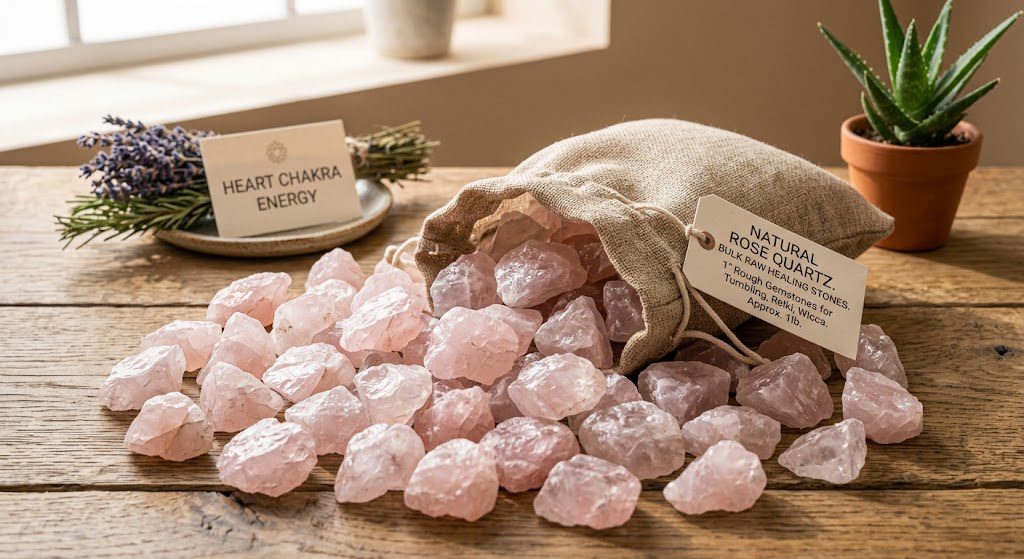
Large raw rose quartz pieces that have carried Amazon's Choice. A good fit if you prefer a natural, unpolished look for display.
Trade-off: raw pieces have rough edges and uneven color. Do not expect a polished finish.
Check on AmazonWhich should you choose?
- Choose amethyst if you want deep color, transparency and a crystal-cluster look for a shelf or desk.
- Choose rose quartz if you want a soft pink stone for carrying, gifting, or a smooth, calm look.
- Skip both if you are hoping for a treatment for a health condition. See a qualified professional for that.
Frequently asked questions
Is amethyst or rose quartz better?
Neither is better in any proven way. Amethyst is clearer and more dramatic. Rose quartz is softer and milkier. Pick the one you like looking at.
Are amethyst and rose quartz the same mineral?
Yes. Both are quartz (SiO₂), and both are 7 on the Mohs scale. The color has different causes.
How can I tell if rose quartz is dyed?
Look for neon-bright color, color concentrated in cracks, or dye that rubs off on a damp cloth. Buying from a seller who states origin and treatments helps.
Can amethyst fade?
Yes. Amethyst can lose color if overexposed to strong light, so keep it out of long, direct sunlight.
Do these crystals heal or affect emotions?
There is no good evidence that they do. In a well-known test, real and fake crystals produced the same reported sensations. Enjoy them as objects, not as treatment.
Final verdict
Choose amethyst for color depth and crystal form. Choose rose quartz for a soft, gentle look and easy-to-carry tumbled stones. Both are quartz, both are durable enough for everyday handling, and neither has been proven to do anything beyond looking good.
The most important step is checking authenticity. If the color looks too perfect or the seller will not say whether it is dyed or coated, walk away.
Sources and further reading
- Mindat, "Rose Quartz: Mineral information, data and localities" (color causes, references to Applin and Hicks, 1987; Goreva et al., 2001)
- Wikipedia, "Amethyst" (iron, irradiation and fading)
- The Quartz Page, "Rose Quartz" (color debate and heat behavior)
- FossilEra, "Rose Quartz Mineral & Crystal Guide" (inclusions and formation)
- Herm J., "Amethyst vs. Rose Quartz" (jewelry comparison, retailer guide)
- TIME, "Do Healing Crystals Actually Work?" (summary of the Goldsmiths study)
- Andrew Weil, "Can Crystals Cure?" (study summary, reported in 2001)